
SOLIDARITY WITH THE PEOPLE OF COLOMBIA AFTER THE ELECTIONS
June 24, 2026
CRLN stands in unwavering solidarity with the people of Colombia at a critical moment. We stand with communities across Colombia and the diaspora defending life, dignity, peace, and democracy in the face of violence, disinformation, and political intervention.
We stand with Colombia because its democratic future is rooted in the struggles of its people—from Indigenous and Afro-Colombian communities to workers, women, youth, and human rights defenders—who have long fought for justice.
Recent gains for peace, democracy, and social justice remain fragile amid threats of renewed militarization, oligarchical control, and political violence.
The defeat of progressive candidate Iván Cepeda, committed to continuing the reform agenda of President Gustavo Petro, marks a setback for progressive forces and reflects a broader regional trend of rising neo-authoritarian, far-right, fascist political currents across Latin America.
The electoral victory of Abelardo De La Espriella must be understood in light of widespread concerns regarding foreign intervention, vote-buying allegations by third actors, and broader irregularities documented by political actors, observers, and civil society organizations. International human rights-based methodologies understand electoral integrity as encompassing not only procedural findings but also the political environment, foreign interference, and conditions under which democratic participation takes place. In this context, questions of legitimacy extend beyond the formal outcome to the conditions under which that outcome was produced.
What happens in Colombia reverberates across the continent.
WE DENOUNCE FOREIGN INTERVENTION IN THE STRONGEST TERMS
We denounce in the strongest terms the intervention of President Donald Trump and other U.S. political figures, including Senator Bernie Moreno (R-Ohio) and Representative María Elvira Salazar (R-Florida), who openly inserted themselves into Colombia’s electoral process. This reflects a long and ongoing history of U.S. interference in Latin America, where sovereign democratic processes are repeatedly subordinated to external political interests.
As Iván Cepeda stated:
“We denounce the open and improper foreign interference in Colombia’s internal affairs, particularly the interventions of the government of the United States and President Donald Trump in favor of a presidential candidacy.”
This interference is not symbolic—it shapes political conditions, deepens polarization, and undermines the autonomy of democratic decision-making.
A PATTERN OF STRUCTURAL VIOLENCE AND IMPUNITY
This electoral moment cannot be separated from deeper structures of violence and historical impunity that continue to shape Colombia’s political life.
The political ascent and electoral victory of presidential candidate Abelardo De La Espriella, and his documented and widely reported ties to paramilitary networks, including the U.S.-designated terrorist organization Autodefensas Unidas de Colombia (AUC), reflects a broader attempt to normalize political projects historically rooted in violence against social movements and popular sectors.
The AUC were responsible for some of the most severe atrocities of Colombia’s armed conflict, including massacres, forced disappearances, sexual violence, torture, and mass displacement. These crimes targeted Indigenous peoples, Afro-Colombian communities, campesinos, trade unionists, and human rights defenders, in direct alignment with the defense of elite political and economic interests.
These concerns are not abstract. As Iván Cepeda warned during his concession:
“We denounce that this campaign involved massive vote-buying operations and sophisticated strategies of manipulation, including the use of artificial intelligence technologies.”
“No electoral victory can be built on practices that degrade democracy. Not everything is permissible in the struggle for power.”
These warnings emphasize a reality of the current moment, legitimacy cannot be reduced to electoral outcome alone, but must be assessed in relation to the conditions under which power is contested, produced, and consolidated.
COMMITMENT TO DEMOCRACY
CRLN remains in solidarity with the people of Colombia as they continue defending democratic space under difficult conditions. We will continue accompanying social movements, victims’ organizations, and diaspora communities in their struggles for peace, truth, and justice.
Democracy belongs to the people—not to foreign powers, not to elites, and not to violence.
CRLN had international certified observers in Bogotá did not observe anything out of the normal, our team in Chicago witnessed voter intimidation and electioneering.
With respect to the voting of Colombians abroad, particularly in the United States, political actors have raised concerns regarding possible irregularities in the functioning of consular polling stations and alleged procedural or access-related problems during the electoral process. These claims have been interpreted within a broader political narrative questioning the integrity of the election and in the context of foreign intervention.
In its official reporting, the Misión de Observación Electoral (MOE) notes that the monitoring of overseas voting locations—including cities such as Miami, New York, and Houston—is integrated into its general electoral observation framework, which primarily records citizen reports and logistical or procedural incidents. Within this framework, the MOE has not identified evidence of systemic fraud or structural manipulation affecting the electoral outcome abroad.
MOE’s technical assessment of electoral irregularities contrasts with broader international observer frameworks, including the Progressive International and international human rights-based methodologies, which emphasize electoral integrity as encompassing not only procedural findings but also the political environment, foreign interference, and conditions under which democratic participation takes place.
CRLN raises serious concerns about the reports of the practice of vote buying which had allegedly been employed by De La Espriella’s supporters throughout Colombia and in the diaspora.
CRLN raises serious concerns about the political and mediatic environment in which the election took place with Abelardo De La Espriella and his supporters using violent rhetoric against supporters of the opposing candidate including a call to “disembowel the left” and nostalgia for right-wing paramilitaries responsible for the deaths of nearly 100,000 Colombians.
As an organization based in the United States, CRLN brings attention to the blatant interference of the Trump Administration in Colombia’s electoral process. This is public support by President Trump for De La Espriella constitutes political intervention, as well as and a smear campaign by congressional republicans and State Department officials against the supporters of Iván Cepeda.
Lastly, CRLN calls for the Department of Homeland Security to immediately release Beto Coral, a Colombian journalist and asylum seeker, who was arrested due to his political beliefs following a direct order from Secretary of State Marco Rubio. He has allegedly been tortured while in detention and ordered to sign his own deportation. CRLN sees Coral’s arrest as an affront to free speech for all residents of the United States and calls on Congress to thoroughly investigate his detention.
We stand in solidarity with the people of Colombia.
We demand the release of Beto Coral.
Archive
THE FUTURE OF COLOMBIA BELONGS TO ITS PEOPLE: DENOUNCING U.S. INTERVENTION IN THE PRESIDENTIAL RUNOFF
June 20, 2026
The Chicago Religious Leadership Network on Latin America (CRLN) stands with Colombia at a critical moment in the country’s democratic history. It is not hyperbole to say that much is at stake for the Latin America continent in these elections. Colombia has made historic advances toward peace, democracy, and social justice under the current government, but those gains remain fragile. The threat of rolling back this progress and returning to a politics of militarization, impunity, and oligarchical rule is very real. What happens in Colombia will resonate across the continent.
CRLN was present in Colombia during the first round of presidential elections on May 21, 2026, accompanying social movements and human rights defenders as part of an international delegation and serving as certified election observers with the Misión de Observación Electoral (MOE).
We are now preparing a second delegation of observers, and will again serve as international election observers during the presidential runoff on June 21, 2026. On election day, CRLN observers will be present at the Colombian Consulate in Chicago.
We reaffirm what we heard directly from Indigenous authorities, Afro-Colombian communities, labor organizers, women’s movements, youth collectives, and human rights defenders: this electoral process is unfolding under intense pressure, including political violence, disinformation campaigns, clientelism, vote-buying by third actors, and coordinated attempts to distort and manipulate public opinion.
While Colombian institutions and the people continue to defend the electoral process, democracy cannot survive if it is undermined both by internal coercion and external interference.
WE DENOUNCE FOREIGN INTERVENTION IN THE STRONGEST TERMS
CRLN condemns the intervention of President Donald Trump and other U.S. political figures such as Senator Bernie Moreno (R-Ohio) and Representative María Elvira Salazar (R-Florida), who have openly inserted themselves into Colombia’s electoral process, attempting to influence the political future of a sovereign nation. Such actions reflect a long history of U.S. imperial interference in Latin America, where democratic processes have too often been subordinated to Washington’s political and economic interests. President Donald Trump has openly endorsed a candidate with documented and widely reported ties to paramilitary networks, and sought to influence Colombia’s electoral process.
We are also troubled by the silence of senior U.S. officials, including Secretary of State Marco Rubio, Acting Attorney General Todd Blanche, and Treasury Secretary Scott Bessent. At a moment when Colombia’s sovereignty is being challenged by external political pressure, their responsibility is not to enable or ignore interference, but to defend international norms of non-intervention and investigate credible allegations concerning the candidate receiving support from influential U.S. political figures.
These officials who have openly intervened in Colombia’s electoral process have directly endorsed presidential candidate Abelardo de la Espriella, effectively transforming Colombia’s democratic decision-making into an extension of U.S. domestic political agendas.
Reports of presidential statements implying that Colombia’s access to U.S. political, economic, or security support could depend on the outcome of its election represent an unacceptable form of coercive diplomacy. This is not neutrality. It is pressure. It is interference. It is imperial conditioning of sovereignty.
Such actions violate the most basic principles of international law, self-determination, and non-intervention, and they reproduce a long and violent history of U.S. intervention in Latin America—where electoral outcomes have too often been treated as matters for external management rather than popular sovereignty.
A PATTERN OF IMPOSING POWER AND STRUCTURAL VIOLENCE
The political elevation of a candidate with documented and widely reported ties to paramilitary networks, U.S.-designated terrorist organizations such as the AUC (United Self-Defense Forces of Colombia / Autodefensas Unidas de Colombia), cannot be separated from this interventionist context.
The AUC were a far-right paramilitary and narco-trafficking organization responsible for some of the worst atrocities of Colombia’s armed conflict, including massacres, assassinations, forced disappearances, torture, sexual violence, and the displacement of millions of people. Acting in defense of elite political and economic interests, the AUC terrorized labor organizers, campesino communities, Indigenous peoples, Afro-Colombian communities, and social movement leaders. The organization was designated a Foreign Terrorist Organization by the United States in 2001.
The documented record presented by journalists and legal investigations includes:
- Connections between the candidate and former leaders of the AUC, responsible for massacres, forced disappearances, sexual violence, and drug trafficking
- Opposition to Colombia’s 2016 Peace Agreement and transitional justice mechanisms for victims
- Financial networks involving shell companies, real estate transactions in Florida, and associations with individuals under federal indictment in the United States
These are not minor controversies. They are indicators of a broader political project that normalizes impunity, weakens transitional justice, and reinforces violent structures of power.
Yet instead of respecting Colombia’s sovereignty, senior U.S. officials have chosen to actively intervene on behalf of this political project.
WE REJECT IMPERIALISM, WE DEFEND PEOPLES’ SOVEREIGNTY
This moment must be understood within the broader historical continuum of U.S. imperialism in Latin America—military coups, covert operations, economic warfare, and political interference that have repeatedly violated the right of peoples to determine their own futures.
Colombia’s election is not a geopolitical instrument. It is not a bargaining chip. It is not an extension of U.S. foreign policy.
It belongs to the Colombian people—and only to them.
We categorically affirm:
- Elections must be decided exclusively by the Colombian people
- All forms of foreign political interference—direct, indirect, coercive, or rhetorical—must cease immediately
- The use of U.S. political power to influence electoral outcomes in Latin America is unacceptable and must be denounced without ambiguity
SOLIDARITY WITH THOSE DEFENDING LIFE AND DEMOCRACY
We stand in unwavering solidarity with Colombia’s social movements, Indigenous peoples, Afro-Colombian communities, workers, women, youth, faith leaders, and human rights defenders who continue to defend democracy under conditions of violence, inequality, and external pressure.
Their struggle is not only for an election. It is for historical memory, territorial dignity, peace with justice, and liberation from both internal repression and external domination.
The future of Colombia belongs to the Colombian people.
Not Washington. Not political elites. Not imperialist interests.
CRLN stands with the people.
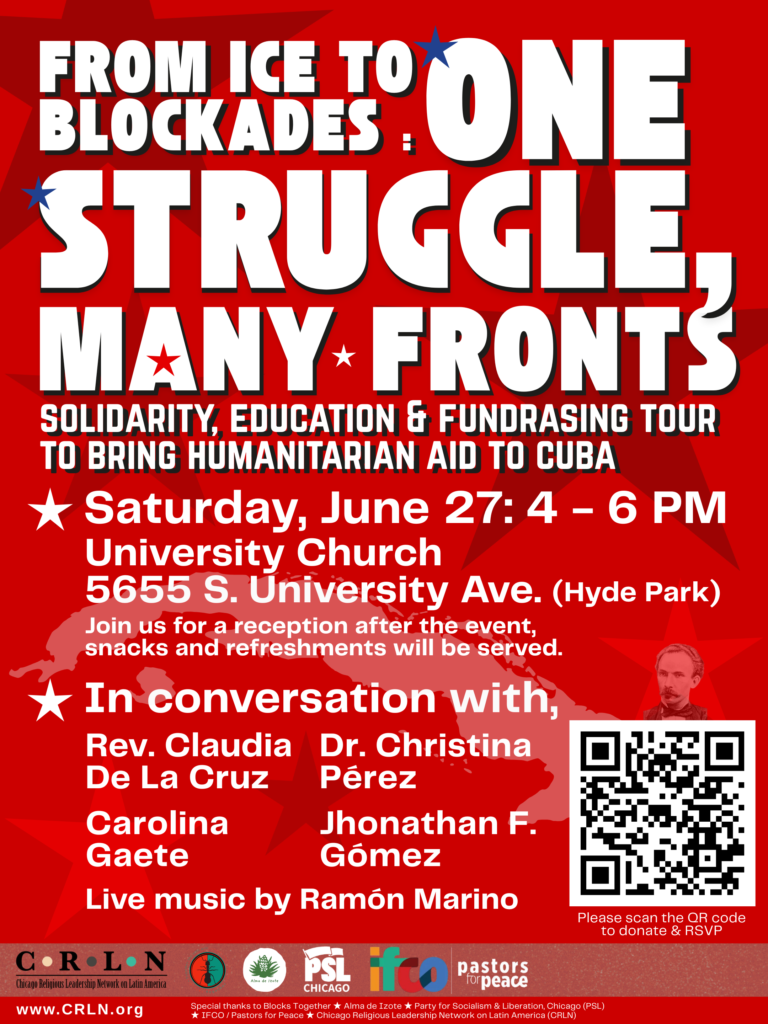
FROM ICE TO BLOCKADES: ONE STRUGGLE, MANY FRONTS
Solidarity, Education & Fundraising Tour to Bring Humanitarian Aid to Cuba
Saturday, June 27, 2026
4:00 PM – 6:00 PM
University Church
5655 South University Avenue
Chicago, IL 60637 (Hyde Park)
Reception to follow. Snacks and refreshments provided.
The Chicago Religious Leadership Network on Latin America (CRLN) is honored to host IFCO/Pastors for Peace as part of its national solidarity, education, and fundraising tour to bring humanitarian aid to Cuba.
CRLN and IFCO/Pastors for Peace share a decades-long history of mutual collaboration and a deep solidarity commitment to the people of Cuba.
At a time when the United States continues to impose devastating economic sanctions and maintain a decades-long blockade against Cuba, international solidarity remains as urgent as ever. For decades, CRLN has stood with the Cuban people because we believe it is both a moral and political imperative to oppose U.S. intervention, economic coercion, militarization, and neocolonial policies that seek to undermine the sovereignty of nations throughout Latin America and the Caribbean.
The Cuban people have the right to determine their own future free from external interference. We stand with Cuba in the same spirit that Cuba has stood with peoples across the world through international medical brigades, disaster response efforts, educational exchanges, and movements for justice and self-determination. As communities across the United States organize against ICE raids, endless wars, and growing inequality, this event invites us to connect our struggles and strengthen our commitment to international solidarity.
Join us for an evening of political education, dialogue, music, and fundraising in support of humanitarian aid destined for Cuba.
Featured Speakers for our Conversation
Rev. Claudia De la Cruz
Rev. Claudia De la Cruz is a community organizer, theologian, popular educator, and mother with nearly three decades of experience building people power. She previously served as pastor of Iglesia San Romero de Las Américas and co-founded The People’s Forum in New York City. Her work has consistently focused on internationalism, political education, and solidarity among working people across borders.
Dr. Cristina Perez
Dr. Cristina Perez is Associate Professor of Sociology and Associate Professor of Women and Gender Studies at Dominican University. A longtime Cuba solidarity activist, her work examines systems of inequality, gender, and social justice. She has dedicated years to building political education and international solidarity efforts in Chicago and beyond.
Carolina Gaete
Carolina Gaete is a popular educator and community organizer who works in solidarity with residents of West Humboldt Park through Blocks Together. Her work focuses on strengthening political consciousness, leadership development, and community-led campaigns. Rooted in Indigenous and African traditions of liberation and self-determination, she is committed to building collective power from the ground up.
Moderated by Jhonathan F. Gómez
Jhonathan F. Gómez is a human rights defender, educator, artist, documentary photographer, and Co-Director of CRLN. Originally from Guatemala City, he has spent nearly two decades working alongside immigrant, Indigenous, and human rights movements in Guatemala and the United States. His work combines organizing, education, and the arts in pursuit of justice and international solidarity.
Musical Performance
Ramón Marino
Ramón Marino is a singer, songwriter, guitarist, visual artist, and educator originally from Mexico City who has lived in Chicago for more than three decades. A longtime performer of Trova and Nueva Canción, his music has accompanied social justice movements and community struggles throughout Chicago. He will join us for a special live musical performance.
Special Thanks
Blocks Together
Alma de Izote
Party for Socialism and Liberation – Chicago
IFCO/Pastors for Peace
All funds raised will support the delivery of humanitarian aid to Cuba.
Join us. Learn. Organize. Build solidarity.