Gráficas de Resistencia: El Salvador 1970–1992 

Todos los septiembres desde 1821 hasta la fecha de hoy, se intenta evocar en nosotros 

sentimientos de amor patrio y civismo. Pasamos por nuestras escuelas escuchando y repitiendo la misma versión acerca de nuestra independencia de España. Ni siquiera es necesario su estudio, reflexión o mayor discusión. Los desfiles son la prioridad. Es ya otra común celebración como cualquier otra celebración cultural, o religiosa. Un olvido académico completo de los estragos sociales, culturales que significó la colonización para nuestros pueblos. 

Pero también puede decirse que septiembre es una oportunidad para reflexionar sobre toda nuestra historia, tan llena de batallas, de luchas, de sacrificios, de rupturas, de luchas que nos han dignificado y nos han dado cierta identidad cultural como pueblo resiliente, rebelde, siempre en busca de libertad, de justicia, de democracia, de soberanía, de paz y de independencia. 

Para hablar de gráficas de resistencia es necesario contextualizar su aparición, su desarrollo, su vigencia. Aquí estamos tratando de hacer un esfuerzo por reconocer no solo esa tradicional fiesta patria, pero también otras fechas importantes en nuestra historia reciente. Me refiero tanto como a las insurrecciones indígenas de 1833, o la insurrección de 1932,—hasta una de las más recientes rupturas históricas que vivió nuestro país: la guerra civil como es llamada por muchos historiadores, que inició y se desarrolló abiertamente en el año 1980. (Sus antecedentes fueron los continuos fraudes electorales ejecutados por sucesivas dictaduras militares y la represión política contra las organizaciones sociales y cualquiera que reclamara un básico derecho humano: salud, vivienda, educación, trabajo digno). 

Esta guerra terminó con un acuerdo de paz entre la dictadura civil militar y la insurgencia popular, fueron acuerdos auspiciados por las Naciones Unidas y ratificados por dos continuas asambleas legislativas de nuestro país en enero de 1992. Mas de 80,000 muertes fue el costo que nuestra sociedad pagó por esos acuerdos de paz. –Asi se cerró un período de conflicto que duró más de 20 años. Ese acuerdo abrió paso a la democratización de nuestra actual sociedad. 

La otra reciente ruptura histórica es la que vivimos actualmente: Esta ruptura inicia con la llegada al poder de nuestro actual gobernante. La persecución política y la represión se vuelve a reestablecer como forma de eliminar enemigos, y reprimir protestas. Se hacen cambios a nuestra constitución política de forma autoritaria, sin mayor debate, y sin ningún consenso nacional. La corrupción administrativa ha adquirido nuevas formas y se ha vuelto práctica normal. Se establece como práctica fiscal la ausencia de transparencia en el uso de los fondos del estado. El país se ha endeudado como nunca en su historia, La deuda pública ya alcanzó en junio pasado a casi $35,000 millones. el 28% del PIB (Producto Interno Bruto) se usa para pagar esa deuda. Nuestro país ha sido descaradamente ofrecido a los Estados Unidos para la construcción de cárceles, y para alojo de prisioneros en lo que puede caracterizarse como una pérdida de dignidad nacional y soberanía. 

Todo lo anterior es un conjuro de condiciones que empieza a acumularse y se refleja en el agravamiento de las condiciones de vida de los más necesitados. Esta más reciente ruptura histórica también merece ser objeto de reflexión de todos y todos los salvadoreños. Es el pasado reciente el que se está repitiendo con nuevas formas y mañas. 

~ 

Yo quisiera hacer una corta reseña de la lucha que se desarrolló en los años 80 y 90: En aquél entonces nos enfrentábamos, – primero a una dictadura militar, – que se convirtió después en militar/civil. Estas dictaduras fueron apoyadas militar, política y económicamente por los Estados Unidos. 

En el contexto de ese enfrentamiento se desarrolló un elemento importante, –la lucha no solo era en el terreno militar, cubrió muchos frentes y niveles de nuestra sociedad. Uno de esos frentes fue la información y propaganda, un componente de eso fue lo que se identificó como “guerra psicológica”, parte de la guerra de contrainsurgencia, esta buscaba afectar la moral, la percepción y sobre todo la conducta de los insurrectos y sus simpatizantes, y se realizaba a través de todos los medios disponibles: prensa, televisión y radio principalmente, es de notar aquí que la mayoría de ellos eran propiedad de familias oligárquicas. 

Como contraparte la insurgencia salvadoreña también hizo uso de cuanto medio fue posible para comunicar, denunciar, educar, organizar, resistir y avanzar. La disputa por los corazones y las mentes de todos los sectores de nuestra sociedad fue hecha por la insurgencia a través de razonamientos y propuestas amplificadas por medios de comunicación construidos durante la lucha misma, todo eso fue acompañado de movimientos culturales y artísticos que crearon sus propios espacios. 

Todas las organizaciones que conformaron la alianza que dirigió esa insurgencia, el FMLN construyeron sus propios medios de comunicación. Todos hicieron periódicos revistas, material impreso educativo y organizativo. La comunicación visual era considerada parte fundamental de ese esfuerzo. Una de esas organizaciones fue el ERP –quienes crearon una estructura especializada para ello –le llamaron COMIN: Comando Internacional de Información, con una dirección descentralizada tenía presencia en Mexico, Nicaragua, El Salvador y Estados Unidos. muchos internacionalistas europeos y latinoamericanos colaboraron con ella. 

Radio Venceremos fue su instrumento comunicativo radial, pero también hicieron Televisión, Cine, Revistas, Periódicos, Libros, incursionaron en otras ramas artísticas como el Teatro, la Música y la producción de Afiches. Dentro de esa estructura un pequeño colectivo bajo la dirección de Rafael Lemus (Lito), Chente (campesino de Morazán) y Roland (Internacionalista francés) explotó en creatividad en la producción de afiches. Buena parte de los afiches que están colgados en las paredes de esta galería fueron hechos por ellos, unos son originales y otros son reproducciones. La serigrafia fue su técnica favorita, sus afiches están cargados de imágenes fotográficas en alto contraste donde predomina la figura humana y el texto necesario para entregar el mensaje.  

El otro medio que utilizaron fue la impresión a offset, sobre todo los producidos en Mexico en donde tenían mayor acceso al equipo y los materiales. Observando esos afiches uno descubre no solo las formas, sino la estampa gráfica de las características de esa guerra: combatientes armados; mujeres, hombres, jóvenes, llamados a la insurrección, denuncias de capturas, denuncias de violaciones de convenciones internacionales, denuncias de violaciones a los derechos humanos y civiles. 

Todo eso fue y es gráfica de resistencia. Observen un pequeño poster del tamaño doble carta, tinta negra y roja con la figura de un campesino alzando una cuma, está hecho con técnica de esténcil cortado a mano en donde la tinta es depositada con un trapo hecho nudo, le llamaban “chuponeado”. Una técnica en la que cualquier superficie puede ser utilizada como lienzo para reproducir la imagen. 

Eso ni se enseña, ni se aprende en aulas, sino en la lucha, en la calle. 

Es un afiche que reclama derechos laborales, en el contexto de la celebración del primero de mayo, día de los trabajadores, es una clara imagen de rebeldía y resistencia. Algunos de esos afiches rescatan imágenes hechas en el siglo pasado, como es el caso donde aparece una mujer con un niño o niña en sus brazos, en color negro, en una acción que muestra protección y que grita ¡resistencia!. Esa imagen es un grabado en linóleo de una artista mexicana que se llama Andrea Gómez. –lo hizo en 1957. Un taller en San Francisco de nombre “La Raza Graphics” uso la imagen, son sus autores, el taller dejo de existir en 1995. Es de notar también que casi la misma imagen se repite de la misma forma a color y con técnica serigráfica en un afiche sin texto donde una niña se funde en un abrazo con una mujer combatiente. Las dos imágenes le hablan al que las observa invitándonos a conversar con ellas. 

El poster que exige la libertad de los presos políticos hecho por las Ligas Populares 28 de febrero, –la primera vez que lo vi fue en las paredes del mercado Modelo en San Salvador–. —Ese poster había sido pegado por todo el centro de San Salvador. La gente preguntaba por los nombres de quienes estaban en las fotos.  

Las gráficas de resistencia tienen objetivos específicos, y muchas no se hacen con pretensiones artísticas o estéticas, ni para decorar salas, por lo general siempre son las que acompañan las luchas de los trabajadores. Pero hay otras que nos insinúan las búsquedas de identidad cultural, todas cobijadas por un mismo espíritu de rebeldía.  

Es de hacer notar que muchos más artistas participaron en la creación de ellas usando otros medios: oleos, acrílicos, dibujos a lápiz, murales, estampados en madera, en semillas, en tela, es siempre nuestro pueblo artesano haciendo uso de la imaginación para sobrevivir, resistir. 

—Hoy en día la lucha por los corazones y las mentes de los pueblos ha cobrado impensables manifestaciones comunicativas… Son otras las características que han adquirido y tienen hoy tantas manifestaciones comunicativas y artísticas…–lo que antes fue “guerra psicológico” hoy se le llama “guerra mediática” y sin extenderme tanto en eso solo quisiera pintar con brocha grande y general lo que algunos consideramos es: La era del desarrollo de las tecnologías digitales volvió casi obsoleto el papel y la tinta, las imágenes hoy principalmente se reproducen a través de pequeñas pantallas con una masificación adictiva en su uso y alcanza a todos los sectores de la sociedad a una velocidad increíble. El resultado es paradójico: es una guerra mediática sin fronteras, sin límites y cualquiera puede desarrollarla desde cualquier parte del mundo; toda imagen transmitida disputa la atención, la memoria, las emociones, con el objetivo final de inducir una conducta colectiva. 

Mientras más insultos, mentiras, amenazas son fabricados y diseminados por especializados centros conductores de esa guerra; más se ha profundizado la lucha por el despojo de los recursos naturales, de los derechos sociales, de todo Latinoamérica. 

El imperio estadounidense no descansa, ni duerme, ni vacila en usar todo su poderío económico, militar, y político para garantizar su propia existencia; mientras tanto nuestros pueblos continúan sumidos en la pobreza, la desesperación y la subordinación. Mucha gente gracias a esa “manipulación digital” “democratizada” ya empiezan a perder la capacidad de distinguir entre la realidad y lo artificial, de distinguir entre aquellos que se nos presentan como referentes de valores democráticos humanistas, superiores y los que resistimos sus imposiciones. Resistir hoy tiene un significado mucho más complejo, pues ya no se trata de resistir la agresión militar, visible, violenta, como lo fue la conquista y la colonización, hoy es resistir políticas de neo–colonialismo, resistir la mentira, los bloqueos económicos, las amenazas intervencionistas, la fabricación de narrativas que abonan los caminos para más despojo, más conflictos, más guerras, más reducción de nuestros derechos a la vida digna, justa. 

En las luchas de resistencia del pasado están las semillas de las nuevas formas de lucha, de información, de educación, de organización, de resistencia. Incorporar todo lo positivo que nos muestran estas gráficas en las paredes digitales es para los creadores de gráficas un reto: el trabajo, creatividad, pasión, humildad, resiliencia, colectivismo, solidaridad, unión, es eso lo que nos permitirá salvar la diversidad de colores, matices, sombras, líneas, letras, figuras, texturas, que siempre han conformado nuestros pueblos. 

Nos corresponde a todos asumir con responsabilidad esos retos. Desde 1970 hasta 1992 un grupo de audaces artistas en nuestro país incorporados en ese colectivo de comunicaciones llamado COMIN nos mostró el camino: –es posible, –es efectivo. Mas de 500 afiches, creaciones gráficas fueron su humilde aporte a la lucha de resistencia. Nos demostraron que el arte popular de resistencia es eso, nace del pueblo, es el pueblo su inspiración, se nutre de el y finalmente es para todos. 

Algún día existirán en nuestro país profesionales bibliotecas públicas donde puedan archivarse sin ningún temor a su destrucción miles de documentos testimonios de nuestra historia de resistencia. 

18st Casa de Cultura Chicago, Il. /Sept 2026 
Read in English / Leer en inglés

Read More

Graphics of Resistance: El Salvador 1970–1992 

Ramiro Ochoa, Salvadoran artist and propagandist  

“This is something neither taught nor learned in classrooms, but rather in the struggle—out on the streets.”  

Since 1821, many attempt to evoke within us feelings of patriotism and civic pride every September. We pass through our schools listening to and repeating the same version of our independence from Spain. Many do not even feel a need for study, reflection, or deeper discussion. Parades are the priority. September has become just another common celebration, like any other cultural or religious holiday. There is a complete academic omission of the social and cultural devastation that colonization meant for our peoples. 

But it can also be said that September is an opportunity to reflect on our entire history—so full of battles, struggles, sacrifices, and ruptures—struggles that have dignified us and given us a distinct cultural identity as a resilient, rebellious people, forever in pursuit of freedom, justice, democracy, sovereignty, peace, and independence. 

To discuss the graphics of resistance, it is necessary to place their emergence, development, and ongoing relevance into context. Here, we are striving to acknowledge not only our national Independence day but also other significant dates in our recent history. This includes the Indigenous uprisings of 1833 and the insurrection of 1932 to one of the most recent historical ruptures our country experienced: the Salvadoran Civil War—as many historians call it—which began and unfolded openly in 1980. (Its antecedents lay in the persistent electoral fraud perpetrated by successive military dictatorships and the political repression directed against social organizations and anyone demanding basic human rights: healthcare, housing, education, and dignified work.) 

This war ended with a peace agreement between the civil-military dictatorship and the popular insurgency. These agreements were brokered by the United Nations and ratified by two successive legislative assemblies of our country in January 1992. Our society paid a price of more than 80,000 lives for those peace agreements. Thus, a period of conflict lasting over 20 years came to a close. That agreement paved the way for the democratization of our current society. 

The other recent historic rupture is the one we are currently living. This break began with the rise to power of our current leader Nayib Bukele. Political persecution and repression have been re-established as methods to eliminate adversaries and suppress protests. Changes to our political constitution are being forced through in an authoritarian manner, without significant debate or any national consensus. Administrative corruption has taken on new forms and become standard practice. A lack of transparency regarding the use of state funds has become the norm in fiscal management. The country has incurred unprecedented levels of debt. As of last June, public debt had reached nearly $35 billion, with 28% of the GDP (Gross Domestic Product) going toward servicing it. Our country has been brazenly offered to the United States for the construction of prisons and the housing of inmates—a move that can only be characterized as a loss of national dignity and sovereignty. 

All of the above constitutes a confluence of conditions that is mounting and is reflected in the worsening living standards of the most vulnerable. This latest historical rupture also warrants reflection by all Salvadorans. It is the recent past that is repeating itself, albeit in new forms and with new tactics. 

~ 

I would like to briefly review the struggle that unfolded during the 1980s and 1990s. At that time, we were confronting, first.y, a military dictatorship, which later evolved into a military-civilian one. These dictatorships received military, political, and economic support from the United States. 

A significant element emerged within the context of this conflict: the struggle was not confined to the military arena but spanned many fronts and levels of our society. One of these fronts was information and propaganda. A component of this was what came to be known as “psychological warfare,” a part of the broader counterinsurgency effort. This strategy aimed to affect the morale, perception, and, above all, the behavior of insurgents and their sympathizers, and it was waged through all available media: primarily the press, television, and radio. It is worth noting that most of these outlets were owned by oligarchic families. 

For its part, the Salvadoran insurgency also utilized every possible means to communicate, denounce, educate, organize, resist, and advance. The insurgency vied for the hearts and minds of all sectors of society by presenting arguments and proposals amplified through media outlets established during the struggle itself. These efforts were accompanied by cultural and artistic movements that created their own spaces. 

All the organizations comprising the FMLN—the alliance that led the insurgency—developed their own media outlets. They all produced newspapers, magazines, and educational and organizational print materials. Visual communication was considered a fundamental part of this effort. One such organization was the ERP, which created a specialized structure for this purpose known as COMIN (International Information Command); operating under decentralized leadership, it maintained a presence in Mexico, Nicaragua, El Salvador, and the United States, with many European and Latin American internationalists collaborating in its work. 

Radio Venceremos was their primary radio-based communication tool, but they also produced television programs, films, magazines, newspapers, and books, while venturing into other artistic fields such as theater, music, and poster design. Within this framework, a small collective—led by Rafael Lemus (“Lito”), Chente (a peasant from Morazán), and Roland (a French internationalist)—demonstrated immense creativity in the production of posters. Many of the posters hanging on the walls of this gallery were created by them; some are originals, while others are reproductions. Screen printing was their preferred technique. Their posters feature high-contrast photographic images, dominated by the human figure and the text necessary to convey the message. 

Another medium they used was offset printing, particularly for works produced in Mexico, where they had greater access to equipment and materials. Upon examining these posters, one discovers not only their visual forms but also the graphic imprint of the war’s defining characteristics: armed combatants; men, women, and youth called to insurrection; and protests against disappearances, violations of international conventions, and breaches of human and civil rights. 

All of this constituted—and still constitutes—graphic art of resistance. Consider a small, double-letter-sized poster printed in black and red ink, featuring a peasant raising a *cuma* (a type of machete); it was created using a hand-cut stencil technique in which ink was applied with a knotted rag—a method known as *chuponeado*. It is a technique that allows any surface to serve as a canvas for reproducing the image. 

This is something neither taught nor learned in classrooms, but rather in the struggle—out on the streets. 

One poster demands labor rights in the context of May Day—International Workers’ Day—serving as a clear symbol of rebellion and resistance. Others revive imagery from the last century. One, for example, features a black-and-white depiction of a woman holding a child: an image conveying protection while simultaneously crying out “resistance!” This image is a linocut by the Mexican artist Andrea Gómez, created in 1957. It was utilized by the San Francisco-based workshop “La Raza Graphics,” which ceased operations in 1995. It is also worth noting that a nearly identical image appears—rendered in color using the screen-printing technique—on a textless poster showing a young girl embracing a female fighter. Both images speak to the viewer, inviting a dialogue. 

The poster demanding the release of political prisoners—created by the February 28th Popular Leagues—was something I first saw on the walls of the Mercado Modelo in San Salvador. That poster had been plastered all over downtown San Salvador. People would ask for the names of the individuals in the photos.  

Resistance graphics serve specific purposes: many are not created with artistic or aesthetic pretensions, nor to decorate living rooms. Generally, they are the images that accompany workers’ struggles. Yet, there are others that hint at a quest for cultural identity, all united by the same spirit of rebellion.  

It is worth noting that many more artists participated in creating these works using various media—oils, acrylics, pencil drawings, murals, and prints on wood, seeds, or fabric—demonstrating how our artisan people use their imagination to survive and resist. 

Today, the struggle for the hearts and minds of peoples has taken on unimaginable forms of communication. The characteristics of these many communicative and artistic expressions have shifted. What was once called “psychological warfare” is now known as “media warfare.” Without dwelling too long on the details, I would simply like to sketch out the big picture as some of us see it: the rise of digital technologies has rendered paper and ink nearly obsolete; images are now primarily reproduced on small screens, with usage becoming addictive and widespread, reaching every sector of society at incredible speed. The result is paradoxical: it is a media war without borders or limits, one that anyone can wage from anywhere in the world; every transmitted image vies for our attention, memory, and emotions, with the ultimate goal of shaping collective behavior. 

The more insults, lies, and threats are fabricated and disseminated by specialized centers orchestrating this war, the deeper the struggle becomes over the plunder of natural resources and social rights across all of Latin America. The U.S. empire neither rests nor sleeps, nor does it hesitate to use its full economic, military, and political might to ensure its own survival. Meanwhile, our peoples remain mired in poverty, despair, and subordination. Thanks to this “democratized” digital manipulation, many people are beginning to lose the ability to distinguish reality from the artificial, or to differentiate between those who present themselves as paragons of superior, humanist democratic values ​​and those of us who resist their impositions. Resistance today carries a far more complex meaning; it is no longer a matter of withstanding visible, violent military aggression—as was the case with the Conquest and colonization. Today, it means resisting neo-colonial policies, lies, economic blockades, and interventionist threats, as well as the manufactured narratives that pave the way for further plunder, conflict, and war, and the continued erosion of our right to a dignified and just life. 

The seeds of new forms of struggle—of information, education, organization, and resistance—lie within the resistance struggles of the past. For graphic creators, incorporating all the positive elements revealed by these graphics on digital walls presents a challenge: hard work, creativity, passion, humility, resilience, collectivism, solidarity, and unity. These are the qualities that will enable us to preserve the diversity of colors, hues, shadows, lines, letters, figures, and textures that have always defined our peoples. 

It is up to all of us to shoulder these challenges responsibly. Between 1970 and 1992, a group of bold artists in our country—part of the communications collective known as COMIN—showed us the way, demonstrating that such efforts are both possible and effective. More than 500 posters and graphic creations represented their humble contribution to the resistance struggle. They showed us that popular resistance art is exactly that: it springs from the people, draws its inspiration from them, is nourished by them, and ultimately belongs to everyone. 

Someday, our country will have professional public libraries where thousands of documents—testaments to our history of resistance—can be archived without any fear of their destruction. 

18st Casa de Cultura Chicago, Il. /Sept 2026 
Leer en español /Read in Spanish

Read More

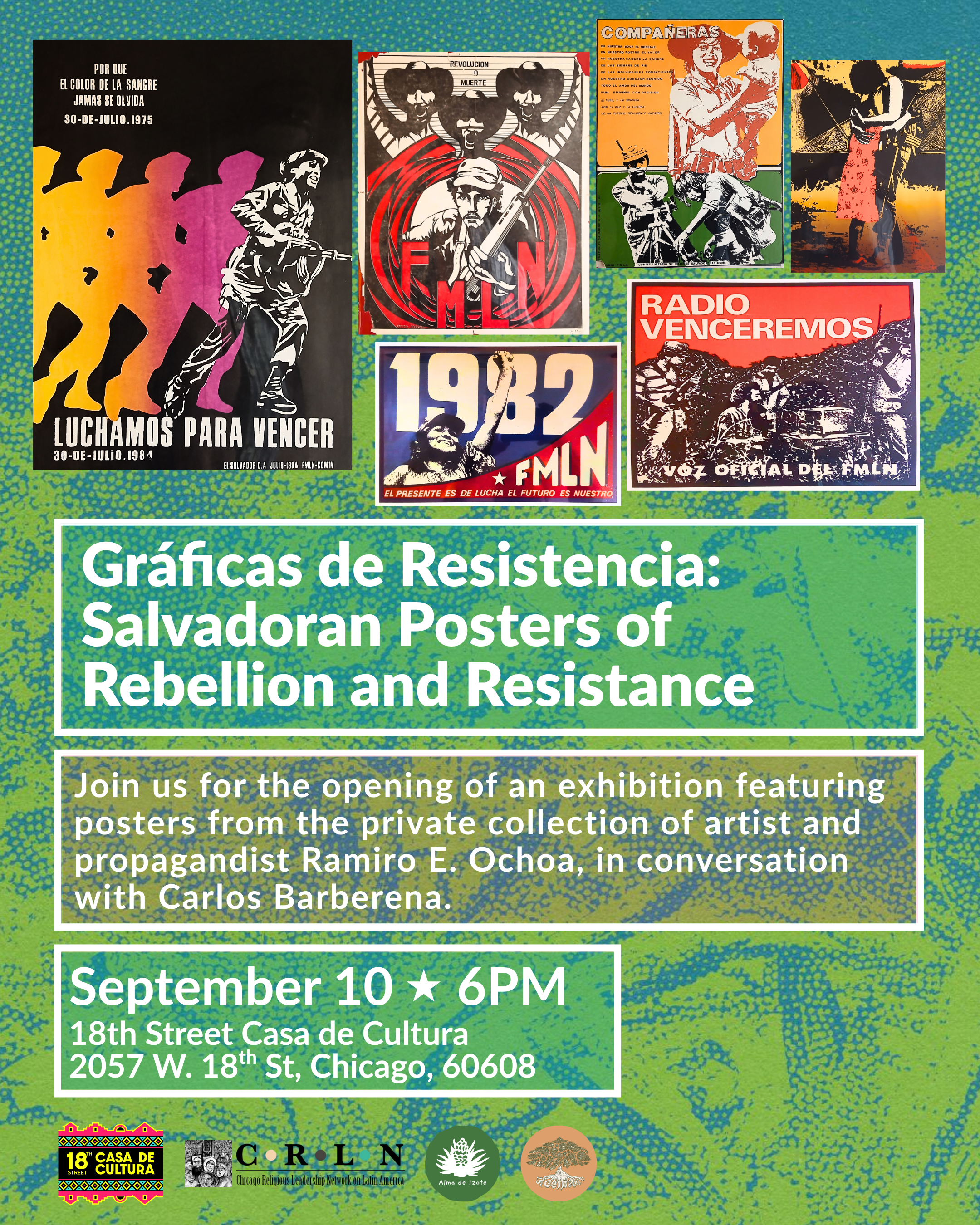
Gráficas de Resistencia:
Salvadoran Posters of Rebellion and Resistance

September 10, 2026 · 6:00 PM
18th Street Casa de Cultura
2057 W. 18th St., Chicago, IL 60608


Join us for the opening of an exhibition featuring posters from the private collection of Ramiro E. Ochoa, Salvadoran artist, graphic designer, and propagandist. The collection brings together political posters from the 1970s and 1980s, offering a glimpse into the art, ideas, and historic memory that profoundly shaped shaped a generation and invite us to think about what those histories can teach us today.

The evening will feature a conversation between Ramiro E. Ochoa and Nicaraguan artist Carlos Barberena, moderated by Jhonathan Gómez of CRLN.

REGISTER NOW


More Than Art

These posters are part of a history of people organizing, resisting, and imagining a different future. During a month when Central American independence is celebrated, ¡Mesoamérica Resiste! invites us to look beyond official histories and remember generations of people who have fought for justice, dignity, and liberation.

Come see the exhibition. Come hear the conversation. Come be part of the discussion.


Throughout September

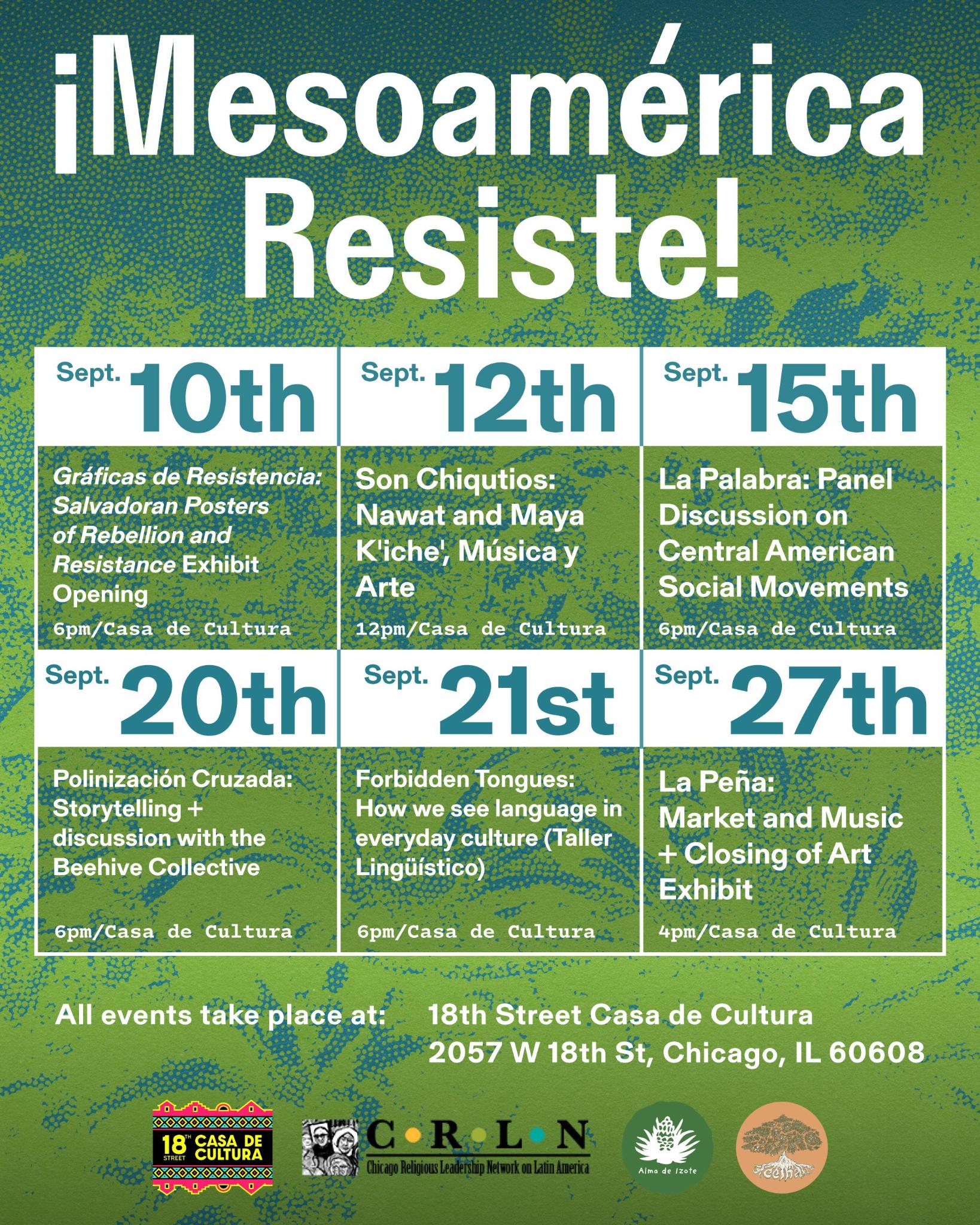
September 12 – 12PM
Son Chiquitos: Nawat and Maya K’iche’, Música y Arte

A signature program of 18th Street Casa de Cultura for children exploring Nawat, an indigenous language form El Salvador and Maya K’iche’, an indigenous language from Guatemala through music and art.

September 15 – 6PM
La Palabra: Panel Discussion on Central American Social Movements

A conversation and panel discussion lead by CEIBA Colectiva about today’s social movements in Central American.

September 20 – 6PM
Polinización Cruzada: Storytelling + Discussion with the Beehive Collective
A volunteer-led artistic and activist collective that creates collaborative, copyright-free images as tools for community education and organizing.

September 21 – 6PM
Forbidden Tongues: Workshop on How We See Indigenous Language in Everyday Culture

Taller Lingüístico / A linguistic workshop, will explore Nawat, an indigenous language form El Salvador and Maya K’iche’, an indigenous language from Guatemala and how they are presented in everyday culture.

September 27 – 4PM
La Peña: Market and Music + Closing of Art Exhibit

An evening of music, vendors, community, and a closing celebration of the art exhibition.


Throughout the month, we’ll come together to remember, reflect, and question the official stories of independence and the power of the state, while celebrating the people and communities who continue to fight every day for human rights, dignity, and self-determination.

Join us as we celebrate how the people of Mesoamérica continue to shape their own history.

📍 18th Street Casa de Cultura
2057 W. 18th St., Chicago, IL 60608


¡Mesoamérica Resiste!


Read More

¡Mesoamérica Resiste!

A month of celebrating and exploring Central American resistance


This September, CRLN and 18th Street Casa de Cultura are glad to partner with Alma de Izote and CEIBA Colectiva for a month of events exploring Central American resistance.

As we enter the month when Central American independence is celebrated, we invite people to look beyond the traditional narratives of nation-states, independence, and colonial history—and to explore how people across the isthmus have resisted and continue to resist colonialism, neocolonialism, exploitation, and state violence through art, music, language, culture, and the work of social movements.

SEPTEMBER 10
Gráficas de Resistencia: Posters of Rebellion

Exhibition Opening • 6 PM

Our inaugural event is a powerful opportunity to connect art, resistance and historic memory.

Gráficas de Resistencia: Posters of Rebellion features the private archives of Salvadoran artist and propagandist Ramiro E. Ochoa, including revolutionary posters from the 1980s and 1990s by various artists alongside Ramiro’s own work.

The event is an exhibition of art and a conversation between Ramiro E. Ochoa and Nicaraguan graphic artist Carlos Barberena, moderated by CRLN Co-Director Jhonathan F. Gomez.

This exhibition invites us to consider the role of art in revolutionary movements—and to ask whose histories, struggles, and visions are remembered when we celebrate independence.

This event is made possible with support from 18th St. Casa de Cultura, Alma de Izote and CEIBA Colectiva.

REGISTER NOW!


Throughout September

September 12 – 12PM
Son Chiquitos: Nawat and Maya K’iche’, Música y Arte1
A signature program of 18th Street Casa de Cultura for children exploring Nawat, an indigenous language form El Salvador and Maya K’iche’, an indigenous language from Guatemala through music and art. Register Here

September 15 – 6PM
La Palabra: Panel Discussion on Central American Social Movements
A conversation and panel discussion lead by CEIBA Colectiva about today’s social movements in Central American. Register Here

September 20 – 6PM
Polinización Cruzada: Storytelling + Discussion with the Beehive Collective

A volunteer-led artistic and activist collective that creates collaborative, copyright-free images as tools for community education and organizing. Register Here

September 21 – 6PM
Forbidden Tongues: Workshop on How We See Indigenous Language in Everyday Culture
Taller Lingüístico / A linguistic workshop, will explore Nawat, an indigenous language form El Salvador and Maya K’iche’, an indigenous language from Guatemala and how they are presented in everyday culture. Register Here

September 27 – 4PM
La Peña: Market and Music + Closing of Art Exhibit
An evening of music, vendors, community, and a closing celebration of the art exhibition. Register Here


Throughout the month, we’ll come together to remember, reflect, and question the official stories of independence and the power of the state, while celebrating the people and communities who continue to fight every day for human rights, dignity, and self-determination.

Join us as we celebrate how the people of Mesoamérica continue to shape their own history.

📍 18th Street Casa de Cultura
2057 W. 18th St., Chicago, IL 60608


¡Mesoamérica Resiste!

Read More

SOLIDARITY WITH THE PEOPLE OF COLOMBIA AFTER THE ELECTIONS
June 24, 2026

CRLN stands in unwavering solidarity with the people of Colombia at a critical moment. We stand with communities across Colombia and the diaspora defending life, dignity, peace, and democracy in the face of violence, disinformation, and political intervention.

We stand with Colombia because its democratic future is rooted in the struggles of its people—from Indigenous and Afro-Colombian communities to workers, women, youth, and human rights defenders—who have long fought for justice.

Recent gains for peace, democracy, and social justice remain fragile amid threats of renewed militarization, oligarchical control, and political violence.

The defeat of progressive candidate Iván Cepeda, committed to continuing the reform agenda of President Gustavo Petro, marks a setback for progressive forces and reflects a broader regional trend of rising neo-authoritarian, far-right, fascist political currents across Latin America.

The electoral victory of Abelardo De La Espriella must be understood in light of widespread concerns regarding foreign intervention, vote-buying allegations by third actors, and broader irregularities documented by political actors, observers, and civil society organizations. International human rights-based methodologies understand electoral integrity as encompassing not only procedural findings but also the political environment, foreign interference, and conditions under which democratic participation takes place. In this context, questions of legitimacy extend beyond the formal outcome to the conditions under which that outcome was produced.

What happens in Colombia reverberates across the continent.

WE DENOUNCE FOREIGN INTERVENTION IN THE STRONGEST TERMS

We denounce in the strongest terms the intervention of President Donald Trump and other U.S. political figures, including Senator Bernie Moreno (R-Ohio) and Representative María Elvira Salazar (R-Florida), who openly inserted themselves into Colombia’s electoral process. This reflects a long and ongoing history of U.S. interference in Latin America, where sovereign democratic processes are repeatedly subordinated to external political interests.

As Iván Cepeda stated:
“We denounce the open and improper foreign interference in Colombia’s internal affairs, particularly the interventions of the government of the United States and President Donald Trump in favor of a presidential candidacy.”
This interference is not symbolic—it shapes political conditions, deepens polarization, and undermines the autonomy of democratic decision-making.


A PATTERN OF STRUCTURAL VIOLENCE AND IMPUNITY

This electoral moment cannot be separated from deeper structures of violence and historical impunity that continue to shape Colombia’s political life.

The political ascent and electoral victory of presidential candidate Abelardo De La Espriella, and his documented and widely reported ties to paramilitary networks, including the U.S.-designated terrorist organization Autodefensas Unidas de Colombia (AUC), reflects a broader attempt to normalize political projects historically rooted in violence against social movements and popular sectors.

The AUC were responsible for some of the most severe atrocities of Colombia’s armed conflict, including massacres, forced disappearances, sexual violence, torture, and mass displacement. These crimes targeted Indigenous peoples, Afro-Colombian communities, campesinos, trade unionists, and human rights defenders, in direct alignment with the defense of elite political and economic interests.

These concerns are not abstract. As Iván Cepeda warned during his concession:
“We denounce that this campaign involved massive vote-buying operations and sophisticated strategies of manipulation, including the use of artificial intelligence technologies.”

“No electoral victory can be built on practices that degrade democracy. Not everything is permissible in the struggle for power.”


These warnings emphasize a reality of the current moment, legitimacy cannot be reduced to electoral outcome alone, but must be assessed in relation to the conditions under which power is contested, produced, and consolidated.

COMMITMENT TO DEMOCRACY

CRLN remains in solidarity with the people of Colombia as they continue defending democratic space under difficult conditions. We will continue accompanying social movements, victims’ organizations, and diaspora communities in their struggles for peace, truth, and justice.

Democracy belongs to the people—not to foreign powers, not to elites, and not to violence.

CRLN had international certified observers in Bogotá did not observe anything out of the normal, our team in Chicago witnessed voter intimidation and electioneering.

With respect to the voting of Colombians abroad, particularly in the United States, political actors have raised concerns regarding possible irregularities in the functioning of consular polling stations and alleged procedural or access-related problems during the electoral process. These claims have been interpreted within a broader political narrative questioning the integrity of the election and in the context of foreign intervention.

In its official reporting, the Misión de Observación Electoral (MOE) notes that the monitoring of overseas voting locations—including cities such as Miami, New York, and Houston—is integrated into its general electoral observation framework, which primarily records citizen reports and logistical or procedural incidents. Within this framework, the MOE has not identified evidence of systemic fraud or structural manipulation affecting the electoral outcome abroad.

MOE’s technical assessment of electoral irregularities contrasts with broader international observer frameworks, including the Progressive International and international human rights-based methodologies, which emphasize electoral integrity as encompassing not only procedural findings but also the political environment, foreign interference, and conditions under which democratic participation takes place.

CRLN raises serious concerns about the reports of the practice of vote buying which had allegedly been employed by De La Espriella’s supporters throughout Colombia and in the diaspora.

CRLN raises serious concerns about the political and mediatic environment in which the election took place with Abelardo De La Espriella and his supporters using violent rhetoric against supporters of the opposing candidate including a call to “disembowel the left” and nostalgia for right-wing paramilitaries responsible for the deaths of nearly 100,000 Colombians.

As an organization based in the United States, CRLN brings attention to the blatant interference of the Trump Administration in Colombia’s electoral process. This is public support by President Trump for De La Espriella constitutes political intervention, as well as and a smear campaign by congressional republicans and State Department officials against the supporters of Iván Cepeda.

Lastly, CRLN calls for the Department of Homeland Security to immediately release Beto Coral, a Colombian journalist and asylum seeker, who was arrested due to his political beliefs following a direct order from Secretary of State Marco Rubio. He has allegedly been tortured while in detention and ordered to sign his own deportation. CRLN sees Coral’s arrest as an affront to free speech for all residents of the United States and calls on Congress to thoroughly investigate his detention.

We stand in solidarity with the people of Colombia.

We demand the release of Beto Coral.


Read More

THE FUTURE OF COLOMBIA BELONGS TO ITS PEOPLE: DENOUNCING U.S. INTERVENTION IN THE PRESIDENTIAL RUNOFF
June 20, 2026

The Chicago Religious Leadership Network on Latin America (CRLN) stands with Colombia at a critical moment in the country’s democratic history. It is not hyperbole to say that much is at stake for the Latin America continent in these elections. Colombia has made historic advances toward peace, democracy, and social justice under the current government, but those gains remain fragile. The threat of rolling back this progress and returning to a politics of militarization, impunity, and oligarchical rule is very real. What happens in Colombia will resonate across the continent.

CRLN was present in Colombia during the first round of presidential elections on May 21, 2026, accompanying social movements and human rights defenders as part of an international delegation and serving as certified election observers with the Misión de Observación Electoral (MOE).

We are now preparing a second delegation of observers, and will again serve as international election observers during the presidential runoff on June 21, 2026. On election day, CRLN observers will be present at the Colombian Consulate in Chicago.

We reaffirm what we heard directly from Indigenous authorities, Afro-Colombian communities, labor organizers, women’s movements, youth collectives, and human rights defenders: this electoral process is unfolding under intense pressure, including political violence, disinformation campaigns, clientelism, vote-buying by third actors, and coordinated attempts to distort and manipulate public opinion.

While Colombian institutions and the people continue to defend the electoral process, democracy cannot survive if it is undermined both by internal coercion and external interference.


WE DENOUNCE FOREIGN INTERVENTION IN THE STRONGEST TERMS

CRLN condemns the intervention of President Donald Trump and other U.S. political figures such as Senator Bernie Moreno (R-Ohio) and Representative María Elvira Salazar (R-Florida), who have openly inserted themselves into Colombia’s electoral process, attempting to influence the political future of a sovereign nation. Such actions reflect a long history of U.S. imperial interference in Latin America, where democratic processes have too often been subordinated to Washington’s political and economic interests. President Donald Trump has openly endorsed a candidate with documented and widely reported ties to paramilitary networks, and sought to influence Colombia’s electoral process.

We are also troubled by the silence of senior U.S. officials, including Secretary of State Marco Rubio, Acting Attorney General Todd Blanche, and Treasury Secretary Scott Bessent. At a moment when Colombia’s sovereignty is being challenged by external political pressure, their responsibility is not to enable or ignore interference, but to defend international norms of non-intervention and investigate credible allegations concerning the candidate receiving support from influential U.S. political figures.

These officials who have openly intervened in Colombia’s electoral process have directly endorsed presidential candidate Abelardo de la Espriella, effectively transforming Colombia’s democratic decision-making into an extension of U.S. domestic political agendas.

Reports of presidential statements implying that Colombia’s access to U.S. political, economic, or security support could depend on the outcome of its election represent an unacceptable form of coercive diplomacy. This is not neutrality. It is pressure. It is interference. It is imperial conditioning of sovereignty.

Such actions violate the most basic principles of international law, self-determination, and non-intervention, and they reproduce a long and violent history of U.S. intervention in Latin America—where electoral outcomes have too often been treated as matters for external management rather than popular sovereignty.


A PATTERN OF IMPOSING POWER AND STRUCTURAL VIOLENCE

The political elevation of a candidate with documented and widely reported ties to paramilitary networks, U.S.-designated terrorist organizations such as the AUC (United Self-Defense Forces of Colombia / Autodefensas Unidas de Colombia), cannot be separated from this interventionist context.

The AUC were a far-right paramilitary and narco-trafficking organization responsible for some of the worst atrocities of Colombia’s armed conflict, including massacres, assassinations, forced disappearances, torture, sexual violence, and the displacement of millions of people. Acting in defense of elite political and economic interests, the AUC terrorized labor organizers, campesino communities, Indigenous peoples, Afro-Colombian communities, and social movement leaders. The organization was designated a Foreign Terrorist Organization by the United States in 2001.

The documented record presented by journalists and legal investigations includes:

  • Connections between the candidate and former leaders of the AUC, responsible for massacres, forced disappearances, sexual violence, and drug trafficking
  • Opposition to Colombia’s 2016 Peace Agreement and transitional justice mechanisms for victims
  • Financial networks involving shell companies, real estate transactions in Florida, and associations with individuals under federal indictment in the United States

These are not minor controversies. They are indicators of a broader political project that normalizes impunity, weakens transitional justice, and reinforces violent structures of power.

Yet instead of respecting Colombia’s sovereignty, senior U.S. officials have chosen to actively intervene on behalf of this political project.


WE REJECT IMPERIALISM, WE DEFEND PEOPLES’ SOVEREIGNTY

This moment must be understood within the broader historical continuum of U.S. imperialism in Latin America—military coups, covert operations, economic warfare, and political interference that have repeatedly violated the right of peoples to determine their own futures.

Colombia’s election is not a geopolitical instrument. It is not a bargaining chip. It is not an extension of U.S. foreign policy.

It belongs to the Colombian people—and only to them.

We categorically affirm:

  • Elections must be decided exclusively by the Colombian people
  • All forms of foreign political interference—direct, indirect, coercive, or rhetorical—must cease immediately
  • The use of U.S. political power to influence electoral outcomes in Latin America is unacceptable and must be denounced without ambiguity

SOLIDARITY WITH THOSE DEFENDING LIFE AND DEMOCRACY

We stand in unwavering solidarity with Colombia’s social movements, Indigenous peoples, Afro-Colombian communities, workers, women, youth, faith leaders, and human rights defenders who continue to defend democracy under conditions of violence, inequality, and external pressure.

Their struggle is not only for an election. It is for historical memory, territorial dignity, peace with justice, and liberation from both internal repression and external domination.

The future of Colombia belongs to the Colombian people.

Not Washington. Not political elites. Not imperialist interests.

CRLN stands with the people.


Read More


Solidarity with the People of Colombia: Denouncing Foreign Intervention in a Historic Electoral Process

May 30, 2026

The Chicago Religious Leadership Network on Latin America (CRLN) is in Colombia and has met with social movement leaders and human rights defenders ahead of the historic presidential elections that will take place tomorrow, Sunday, May 31, 2026. Our delegation will join other international organizations as certified election observers with the Misión de Observación Electoral (MOE).

CRLN echoes the concerns of social movement leaders and human rights defenders who have warned of violence, disinformation, and foreign interference in Sunday’s election.

These elections are taking place amid an atmosphere of political violence. Hundreds of reported acts of violence, threats, and attacks targeting political, social, and community leaders, are deeply alarming and raise serious concerns about efforts to generate fear, restrict participation, and influence the democratic process. The Misión de Observación Electoral (MOE) has repeatedly warned of increasing risks related to political violence, disinformation campaigns, attacks on political leadership, and threats to democratic participation across the country. While the Colombian government has taken important steps to guarantee the electoral process, reports of vote-buying by third actors, clientelism, electoral irregularities, and misinformation threaten to undermine democratic participation.

We are especially concerned by the growing evidence of foreign interference. By U.S. politicians, including Senator Bernie Moreno (R-Ohio) and Representative María Elvira Salazar (R-Florida). Their statements must be denounced because they appear to favor certain political sectors, question the legitimacy of votes from particular regions, or seek to influence public opinion ahead of the election. Ecuadorian President Daniel Noboa has also drawn criticism for actions and statements that many Colombians view as attempts to influence the electoral process.

These developments must be understood within the broader history of U.S. intervention in Latin America. For generations, governments, corporations, and political actors from the United States have sought to shape political outcomes across the region at the expense of popular sovereignty and self-determination. Many international human rights organizations, as well as the people of Honduras concluded that U.S. interference likely influenced voters and affected the political environment.

The people of Colombia have every right to be concerned that similar efforts could impact their own democratic process. The future of Colombia belongs to the Colombian people. Only the people of Colombia can decide their future.

We stand in solidarity with Colombia’s social movements, Indigenous peoples, Afro-Colombian communities, workers, women, youth, faith leaders, and human rights defenders who continue to work and fight for democracy, peace, justice, and liberation.


Chicago Religious Leadership Network on Latin America (CRLN)

Read More

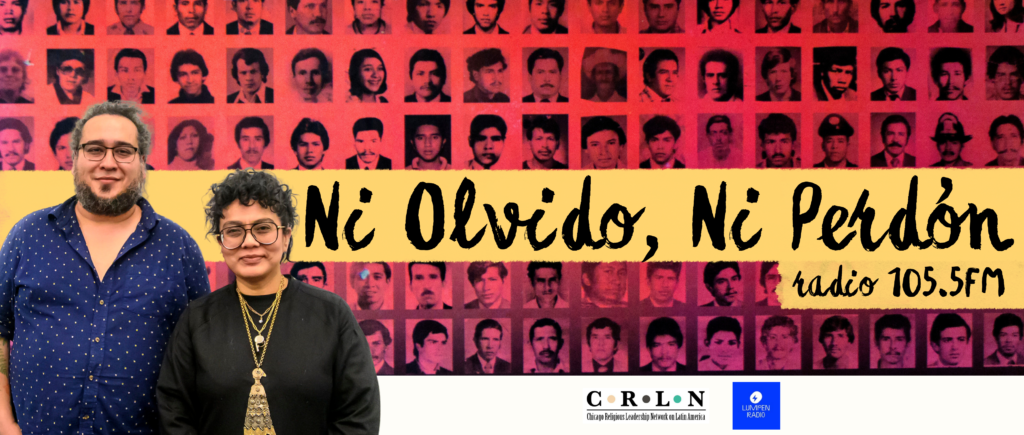
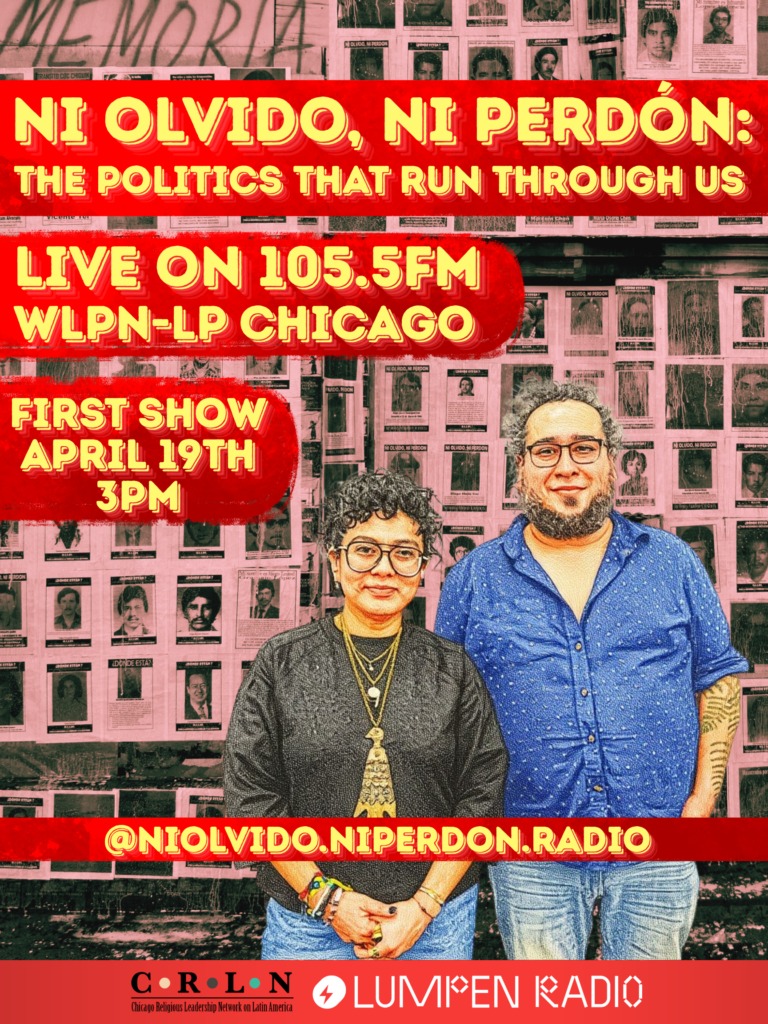
CRLN on the Radio: Ni Olvido, Ni Perdón

It is not every day that we get to announce a new project. At the Chicago Religious Leadership Network on Latin America (CRLN), we are very proud to present to you a new initiative that connects deeply with our historic work and with a perspective aimed at the future. Ni Olvido, Ni Perdón Radio: La política que nos atraviesa / The Politics That Run Through Us, will be a new space for historical memory, political education, and solidarity.

Our new radio show will be co-hosted and co-produced by Jhonathan F. Gómez, co-director of CRLN, and Dr. Lydia Saravia, university professor and former CRLN board member. We have envisioned it as a place for multigenerational dialogue, political education, and cultural reflection rooted in Central American thought the living histories of the diaspora in Chicago. Ni Olvido, Ni Perdón, “Neither Forgetting Nor Forgiving” is not just a phrase, it is a political commitment rooted in the experiences of those who have lived through state violence, displacement, and resistance. A space to remember histories, to challenge silence and distortion, and to connect them to the ongoing struggles for justice today.

Through interviews, storytelling, and analysis, the radio program will feature human rights defenders, organizers, and community voices from countries such as Guatemala, Honduras, and El Salvador, as well as from communities organizing in Chicago and across the United States. It will also highlight cultural expression as a vital part of preserving memory and sustaining movements.

At its core, the program seeks to connect past and present, linking struggles across borders and generations. It is both a place for reflection and a tool for action—strengthening relationships of solidarity and contributing to broader movements for human rights and dignity.

We invite you to listen with us the first Sunday of each month at 3PM on WLPN LP 105.5 FM, Lumpen Radio. This project is a collaboration with Lumpen Radio. The first show will be on Sunday, April 19 at 3PM. You can also listen online at https://lumpenradio.com/

And if you are on Instagram, give the project a follow and like; https://www.instagram.com/niolvido.niperdon.radio/

Stay tuned for upcoming episodes, guest speakers, and ways to engage.

Read More

Updated August 20, 2026

As the Trump Administration continues policies to strangle the Cuban economy, a number of bills have been introduced in the House and Senate to stop the US from military action against Cuba and to finally end the US embargo of Cuba.  Our goal is to get our legislators to support these bills to show they don’t support the current genocidal policies.

Let’s get as many legislators as possible on record supporting a future of mutual benefit.

📞 Click here to look up your Senators’ phone numbers.

📞 Click here to look up your Representative’s phone number.

Call and use these sample scripts or craft your own!

For Senators:

“My name is [YOUR NAME] from [YOUR CITY]. I’m calling to urge [Senator NAME] to vote YES on Sen. Kaine’s War Powers Resolution — that is, S.J.Res.193 — to stop the United States from going to war with Cuba. Congress must reassert its constitutional power over military action. Additionally, I urge the senator to support Sen. Wyden’s bill, S.136, to lift the trade embargo on Cuba. Thank you.”

For Representatives:

“My name is [YOUR NAME] from [YOUR CITY]. I’m calling to urge [Representative NAME] to vote YES on Rep. Velázquez’s War Powers Resolution — that is, H.Con.Res.106 — to stop the United States from going to war with Cuba. I also urge the representative to vote YES on Rep. Jayapal’s resolution, H.R. 8103, to prevent the use of funds for military action against Cuba. Congress must reassert its constitutional power over military action. Finally, I want to ask the representative to support Rep. McGovern’s bill, H.R.7521, to lift the trade embargo on Cuba. Thank you.”


A big thanks to the Latin American Working Group for contributions to this action alert!

Read More

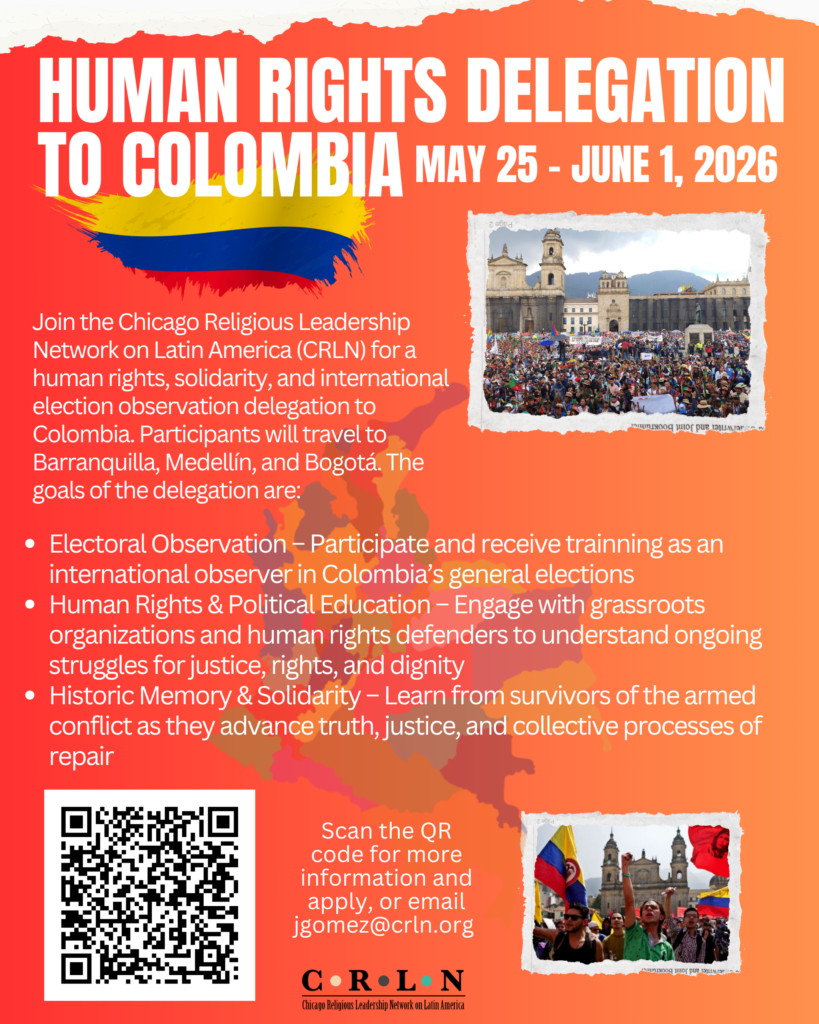
Human Rights & Election Observation Delegation to Colombia


The Chicago Religious Leadership Network on Latin America (CRLN) builds partnerships among social movements and communities in the U.S. and Latin America, using popular education, grassroots organizing, advocacy, and direct action to challenge U.S. militarism, neoliberalism, and other forms of state violence, guided by liberating faith traditions and a commitment to human dignity.

For over two decades, CRLN has engaged in faith-rooted solidarity with human rights defenders and resistance communities in Colombia, challenging U.S. policies like Plan Colombia that fueled militarization, displacement, and human rights abuses, especially impacting Afro-Colombian and Indigenous communities. CRLN has accompanied and advocated for displaced peoples, opposed aerial fumigation, and supported the implementation of the 2016 Peace Accords, including protections for defenders and the right of communities to return to their lands.

CRLN invites you to join us for a human rights and election observation mission taking place from May 24 to June 1, with Colombia’s general elections scheduled for Sunday, May 31.

The delegation will serve as a space for political education, solidarity, and international election observation. Participants will receive training and serve as observers during Colombia’s general elections, engaging directly with local monitoring efforts and examining what the electoral process means for historically excluded communities.

Participants will analyze Colombia’s current political and human rights landscape through engagement with grassroots movements and human rights defenders. They will hear firsthand testimonies that ground political analysis in lived experience. Participants will also engage in dialogue with survivors of the war in a post-war context, learning how they are advancing processes of truth, justice, and collective repair. Together, these experiences will offer a deeper understanding of Colombia’s social and political realities while strengthening international solidarity with communities working toward peace and liberation.

Apply by filling out the online application. Applicants will be informed if they have been invited to attend the delegation by May 4, 2026.

Apply here: https://forms.gle/ZfwUByN4bvvCgUiJA If you have questions or would like more information contact Jhonathan Gómez at jgomez@crln.org.


Delegation Goals

  1. Electoral Observation
    ● Serve as an international observer during Colombia’s general elections (May 31)
    ● Receive training and engage directly with local observation missions, civil society organizations, and electoral monitors
    ● Examine what elections mean for historically excluded communities, as well as survivors of the armed confl ict
  2. Human Rights & Political Education
    ● Learn about human rights conditions in Colombia through engagement with grassroots organizations, movements, and human rights defenders
    ● Analyze the current political landscape and its relationship to electoral politics
    ● Hear firsthand testimonies that ground political analysis in lived experience
  3. Historic Memory & Solidarity
    ● Engage with survivors of the armed confl ict to understand processes of memory, truth, and collective repair
    ● Learn from survivor-led efforts to advance justice and reconciliation in a post-war context
    ● Build relationships grounded in solidarity with communities working toward truth and collective healing

Who Should Apply?

  • Organizers, activists, college students
  • People committed to international solidarity and social justice
  • Individuals willing to engage respectfully with communities

Cost

  • Sliding scale of $1,600 – $1,400 / This price does not include fl ights to Colombia
    (The sliding supports CRLN’s fi nancial assistance to delegation participants who request it)
  • ✔ Includes housing, most meals, in country transportation, and delegation coordination
  • ✈ Flights estimated: $600–$900, depending the date purchased
  • X THE COST DOES NOT INCLUDE FLIGHTS TO COLOMBIA. Flights must be purchased by participants.

Delegation Size?

  • 8–14 participants

Payment Timeline

  • Unrefundable deposit: $250 (upon acceptance)
  • Final balance due 3 weeks before departure date
  • Financial support available

Delegation Requirements, Participants are Required to:

  • Attend 2 pre-delegation Zoom meetings – Review and study background materials on Colombia’s social and political contex
  • Advanced level of comprehension of the Spanish language is required
  • Participants are expected to participate fully in all meetings, and activities of the delegation, including the work that will happen as an international election observer.
  • Participants are expected to participate in collective post-delegation report-back and public education, and advocacy efforts.

How to Apply

Apply by filling out the online application. Applicants will be informed if they have been invited to attend the delegation by May 4, 2026.

Apply here: https://forms.gle/ZfwUByN4bvvCgUiJA

Applicants will be informed if they have been invited to attend the delegation by April 24, 2026. If you have questions or would like more information contact Jhonathan Gómez at jgomez@crln.org.

Read More