
image-title


Bill Summary: 

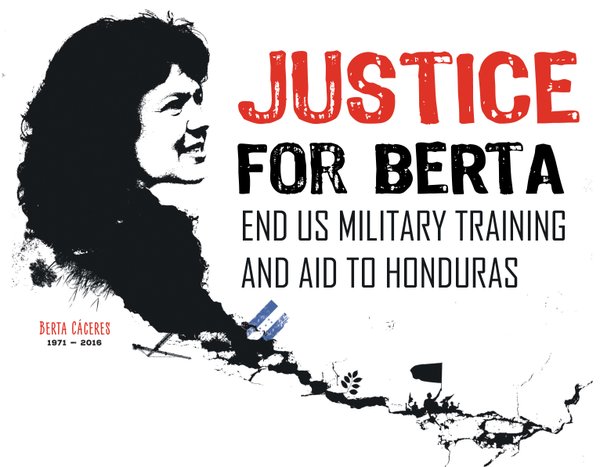
This bill prohibits funds from being made available to Honduras for the police or military (including for equipment and training), and directs the Department of the Treasury to instruct U.S. representatives at multilateral development banks to vote against any loans for the police or military of Honduras, until the Department of States certifies that the government of Honduras has:

  • prosecuted members of the military and police for human rights violations and ensured that such violations have ceased;
  • established the rule of law and guaranteed a judicial system capable of bringing to justice members of the police and military who have committed human rights abuses;
  • established that it protects the rights of trade unionists, journalists, human rights defenders, government critics, and civil society activists to operate without interference;
  • withdrawn the military from domestic policing; and
  • brought to trial and obtained verdicts against those who ordered and carried out the attack on Felix Molina and the killings of Berta Caceres, Joel Palacios Lino, Elvis Armando Garcia, and over 100 small-farmer activists in the Aguan Valley.


Current co-sponsors:

60 total in U.S.; from IL – Schakowsky, Lipinski, Gutierrez, Rush, Davis, Quigley, Foster


Reasons to Co-sponsor
:

  1. The U.S. should not fund security forces that have committed such an alarming number of human rights abuses with a 97% impunity rate.

    Some argue that U.S. training for Honduran troops will professionalize them, but there is no evidence of improvement since the 2009 military coup d’etat. Those who planned that coup
    are still in power. In fact, there is credible evidence that units of the Honduran military trained by the U.S. are operating as “death squads” and have hit lists of the leaders of various social movements. Berta Cáceres was one casualty.

    https://www.theguardian.com/world/2017/feb/28/berta-caceres-honduras-military-intelligence-us-trained-special-forces
  2. The U.S should not entrust funds to an administration as corrupt as that of Juan Orlando Hernández’ in a country with such a weak judicial system.

    We cannot have any confidence that funds given to Honduras will be used for their intended purpose. There is rampant institutional corruption in Honduras. High-level officials siphon off money from public institutions for their own gain or for political advantage. The looting of at least $350 million from the social security system by its chief administrator, part of which funded National Party efforts to elect current President Hernández in 2013, is an example.

    The Unbearable Solitude of Honduras’ Attorney General


Officials also have been implicated in taking bribes from drug trafficking gangs in exchange for allowing gangs to operate without police interference.

Another Day, Another Damning Testimony of Elites by Honduras Trafficker


3.  U.S. funds should not be sent to support military and police forces in a country which                 appears headed for dictatorship.

Current President Hernández is running for re-election, forbidden by the Honduran Constitution. Last year, he fired 4 Supreme Court justices who challenged the constitutionality of his running for re-election and appointed replacements who would support it. He uses the military in domestic policing, also forbidden by the Constitution, and has formed a Military Police Force in addition to the National Police. This year, the Honduran Congress passed changes to the penal code that threaten free speech and freedom of assembly rights, with stiff criminal penalties, which have citizens worried that they will not be able effectively to publicly oppose government policies.

Read More
image-title

(The New York Times did not print this letter from the Coalition Against Impunity, a group of Honduran civil society human rights organizations)

Re: How the Most Dangerous Place on Earth Got Safer

As the Coalition Against Impunity, a group of Honduran civil society human rights organizations, we strongly disagree that the impact of US aid is positive. Our experience on the ground shows thatviolence is rampant — and seriously underreported—and we still face high levels of impunity. For this reason, we recently sent a letter to the US Congress demanding suspension of aid to the Honduran State under the Alliance for Prosperity, due to the lack of political will to protect human rights.

Nazario’s opinion piece calls for more U.S. aid precisely when a group of 31 legislators led by Rep. Hank Johnson has presented the much-needed “Berta Caceres Human Rights in Honduras Act” to suspend all security aid to Honduras following Caceres’ assassination last March. Among those detained are two army officers, one on active duty.

To cite supposed progress in one neighborhood and deduce that US aid benefits our whole country is either careless or tendentious. The human rights crisis in Honduras will only improve when the US ceases to support a government that commits crimes against its own people with impunity and, rather than being sanctioned, is rewarded with millions of US taxpayer dollars.

The Coalition Against Impunity:

Asociación de Jóvenes en Movimiento (AJEM); Asociación de Jueces por la Democracia (AJD); Asociación de Mujeres Intibucanas Renovadas (AMIR); Asociación Feminista Trans (AFeT); Asociación FIAN Honduras; Asociación Hermanas Misioneras de San Carlos Borromeo Scalabrinianas; Asociación Intermunicipal de Desarrollo y Vigilancia Social de Honduras (AIDEVISH); Asociación LGTB Arcoiris de Honduras; Asociación Nacional de Personas viviendo con SIDA (ASONAPVSIDA); Asociación para una Ciudadanía Participativa (ACI-PARTICIPA); CARITAS – Diócesis de San Pedro Sula; Centro de Derechos de Mujeres (CDM); Centro de Desarrollo Humano (CDH); Centro de Educación y Prevención en Salud, Sexualidad y Sida (CEPRES); Centro de Estudios de la Mujer Honduras (CEM-H); Centro de Estudios para la Democracia (CESPAD); Centro de Investigación y Promoción de Derechos Humanos (CIPRODEH); Centro para la Prevención, Tratamiento y Rehabilitación de Víctimas de la Tortura y sus Familiares (CPTRT); Colectivo Diamantes Limeños LGTB; Colectivo Gemas; Colectivo Unidad Color Rosa; Comité de Familiares de Detenidos Desaparecidos de Honduras (COFADEH); Comité de Familiares de Migrantes Desaparecidos de El Progreso (COFAMIPRO); Comité por la Libre Expresión C-Libre; Convergencia por los Derechos Humanos de la Zona Nor Occidental; Crisálidas de Villanueva; Coordinación de Instituciones Privadas por las niñas, niños, adolescentes, jóvenes y sus derechos (COIPRODEN); Equipo de Monitoreo Independiente de Honduras (EMIH); Equipo de Reflexión, Investigación y Comunicación (ERIC-SJ); Feministas Universitarias; Familia Fransciscana de Honduras (JPIC); Frente Amplio del COPEMH; Foro de Mujeres por la Vida; Foro Nacional para las Migraciones (FONAMIH); Foro Social de la Deuda Externa y Desarrollo de Honduras (FOSDEH); Indignados Unidos por Honduras; JASS en Honduras; Movimiento Amplio por la Dignidad y la Justicia (MADJ); Movimiento Diversidad en Resistencia (MDR); Movimiento de Mujeres por la Paz “Visitación Padilla”; Observatorio Permanente de Derechos Humanos de El Aguán; Organismo Cristiano de Desarrollo Integral (OCDIH); Pastoral de Movilidad Humana de Honduras; Red de Mujeres Jóvenes de Cortés; Red de Mujeres Unidas de Colonia “Ramón Amaya Amador”; Red de Participación de Organizaciones de Sociedad Civil Siguatepeque (RPOSC); Red Nacional de Defensoras de Derechos Humanos en Honduras; Tribuna de Mujeres contra los Femicidios; Unión de Empresas y Organizaciones de Trabajadores del Campo (UTC – La Paz).

Read More