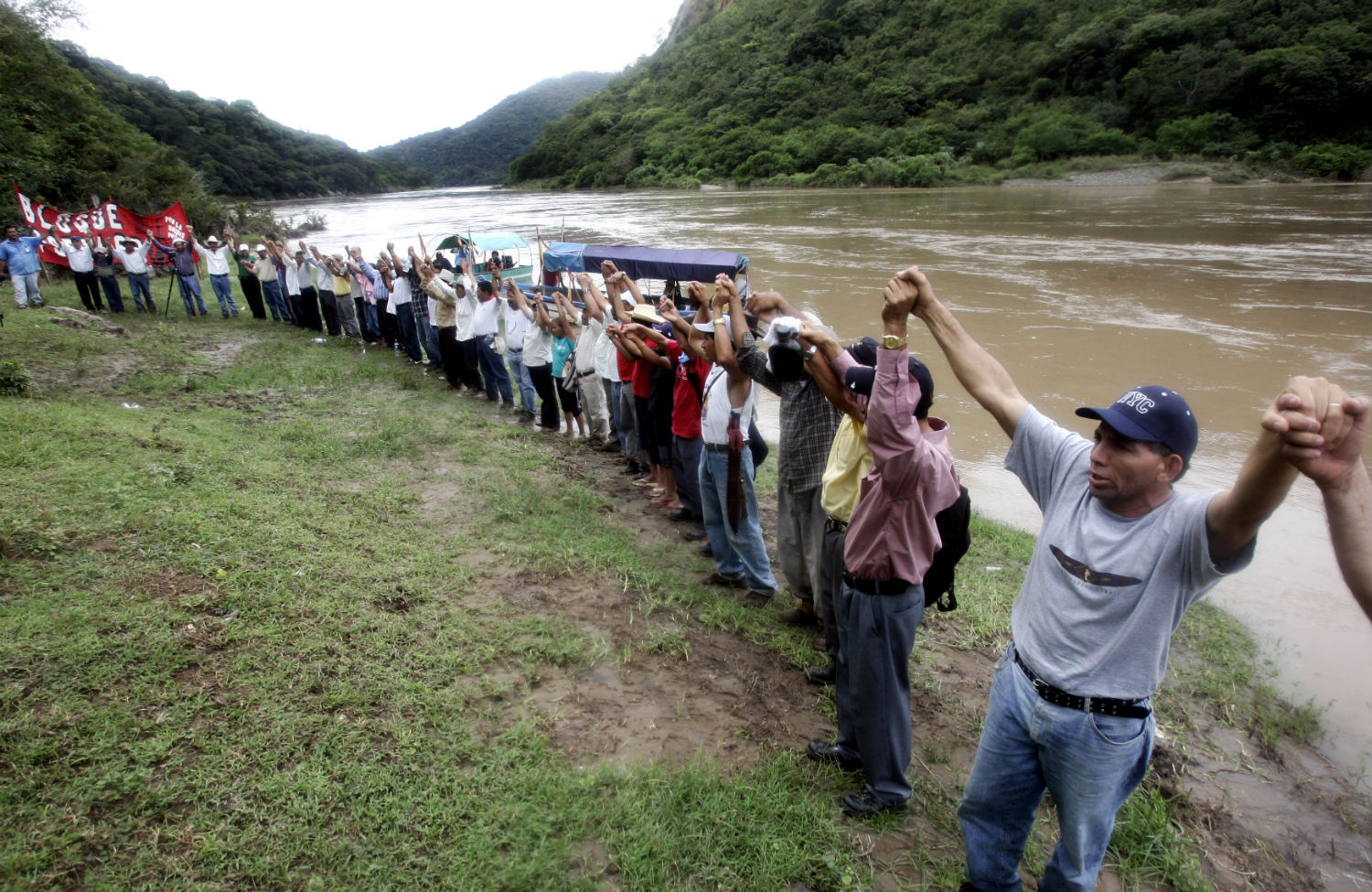
Three CRLN staff and board members traveled to Honduras February 28 – March 8 together with La Voz de los de Abajo, one of CRLN’s partner groups. Below is a reflection by Sharon Hunter-Smith upon visiting two communities engaged in land recuperation as part of the National Center of Rural Workers.
Our group from Chicago stood staring at the rough wooden table, which held 2-dozen or so spent tear gas canisters plus a couple of bullet shells, collected by the 9th of July community from the area immediately surrounding the place where we stood. The largest one, designed to be fired from a rifle, was stamped “Made in U.S.A.” The connection between U.S. military and police aid to Honduras and the violent persecution of impoverished Honduran farmers was crystal clear in the objects before us.
The original rural community of 28 families has been tear gassed and evicted from their simple hand-built dwellings and cultivated land 26 times by the Honduran military or police. In the last surprise eviction on January 13, 2017, the police followed the fleeing people, even women and children, across the valley, shooting all the way. One man was shot in the leg and a pregnant woman miscarried after running away, panicked, from the “security” forces. They also tore down and burned houses, stole or burned possessions and tools left in and around the houses, and cut down some of the fruit trees and crops. Since then, the women and children, have moved to a nearby community while the men have re-occupied the land.
“Thanks be to God that we continue to live on this land,” said one man. After each violent eviction, the community’s commitment is to return and resettle on the land within 24 hours of being pushed off, rebuilding houses and restoring crops as they are able. The bravery and endurance that this strategy demands is fed by their hope of land ownership. They experience other threats in the form of arrest warrants against them and death threats from the national or military police. “Every time we receive a group of international people who are in solidarity with us, it gives us the strength to keep going on with our struggle,” said another.
This community of formerly landless people, organized by the Central Nacional de Trabajadores del Campo (CNTC–National Center of Rural Workers), settled this abandoned and desert-like land in 2010. They dug trenches and bought plastic pipes to carry water for irrigation and drinking water from a spring 3 kilometers away. They planted fruit trees and other crops to feed their families. A dry hillside turned green and provided a way to make a living. The CNTC works with 203 other communities, like 9th of July, who are reclaiming land and putting it to good use in 14 of the 18 Honduran departments (what in the U.S. would be called states).
The National Agrarian Reform Law provides that idle land fit for farming can be expropriated and awarded to indigent and landless persons by the government, but this does not happen often. To force the issue and obtain the land essential for rural people to support themselves and their families, the CNTC works with landless people to settle and plant on unused, undeveloped or abandoned land. The occupants then file for title to the land under the Agrarian Reform Law with Honduran National Agrarian Institute (INA).


ting the country.
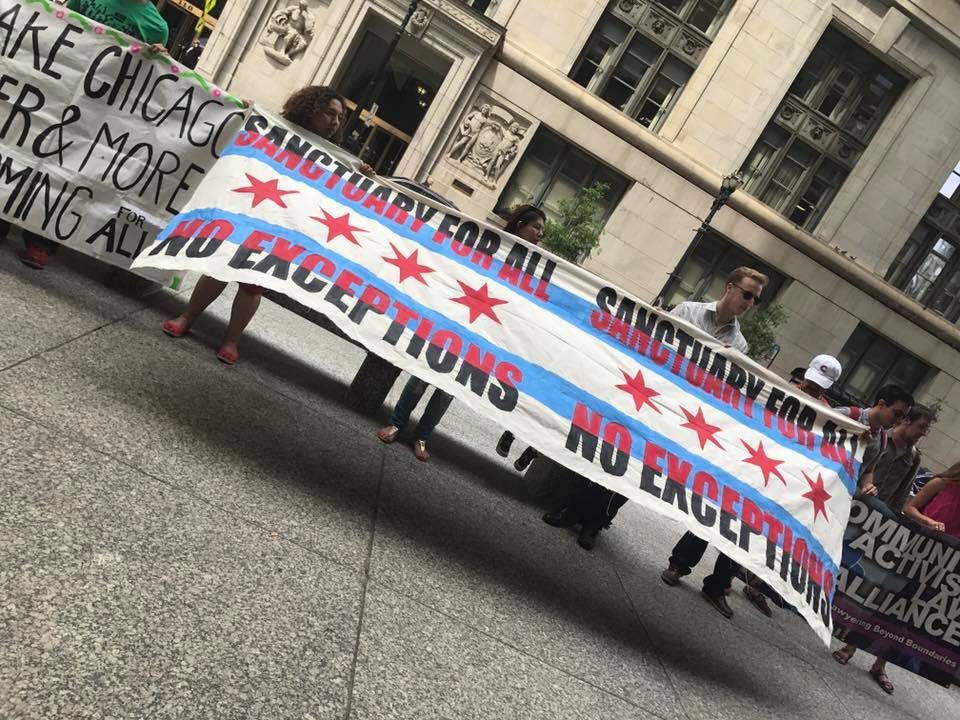
Washington D.C. – Following President Trump’s announcement today aiming to curb Sanctuary Cities, turn away asylum seekers, order the construction of a border wall, and increase harmful enforcement policies mark the start of our resistance. The National Sanctuary movement reaffirms its unwavering support for local jurisdictions with limited detainer policies and continued commitment to protect immigrants and refugees by opening their congregations to those being targeted by Trump’s policies.

In this context, we thank you for your signatures supporting the Berta Cáceres Human Rights in Honduras Act (H.R. 5474). They helped CRLN convince 7 out of 10 Democratic Illinois U.S. Representatives to co-sponsor this important legislation introduced by Rep. Hank Johnson. By the end of 2016, the bill, which would suspend U.S. security aid to Honduras pending compliance with international human rights standards, garnered a total of 52 co-sponsors nationwide.

The 200 signatures delivered to Durbin also appeared on letters to Illinois members of the House urging that they support H.R.5474, the Berta Cáceres Human Rights in Honduras Act, a bill that would also suspend U.S. security aid to Honduras. At this time, seven out of ten Democrats in the Illinois delegation have decided to cosponsor the legislation, a major win that would not have been possible without grassroots pressure from those who signed.
Despite these ongoing attacks, credible accusations of Honduran state complicity, and an ongoing 95% impunity rate, the U.S. has sent over $200 million in police and military aid since the 2009 coup and, last month, the State Department certified—with little to no evidence—the Honduran government for having met human rights conditions, thus releasing $55,000,000 in security aid.
Escrito por Celeste Larkin, Coordinadora de Política Pública de CRLN, Aug de 2012 – Dic de 2016: Los últimos cuatro años y medio en CRLN me han dado una experiencia profunda y un sentido de humildad mientras aprendía, luchaba, y abogaba al lado de una bella comunidad que imagina un mundo donde los derechos humanos tienen más valor que el beneficio privado—y, por eso, estoy profundamente agradecida. Estaré dejando mi posición en CRLN al final de este mes y tomaré conmigo esta visión y todo lo que aprendí del equipo de CRLN, de nuestra junta directiva, de nuestrxs miembrxs, y—lo más importante—de la personas indocumentadas y organizadores de América Latina luchando por sus derechos, sus vidas y sus tierras.