image-title

(Leer en español)

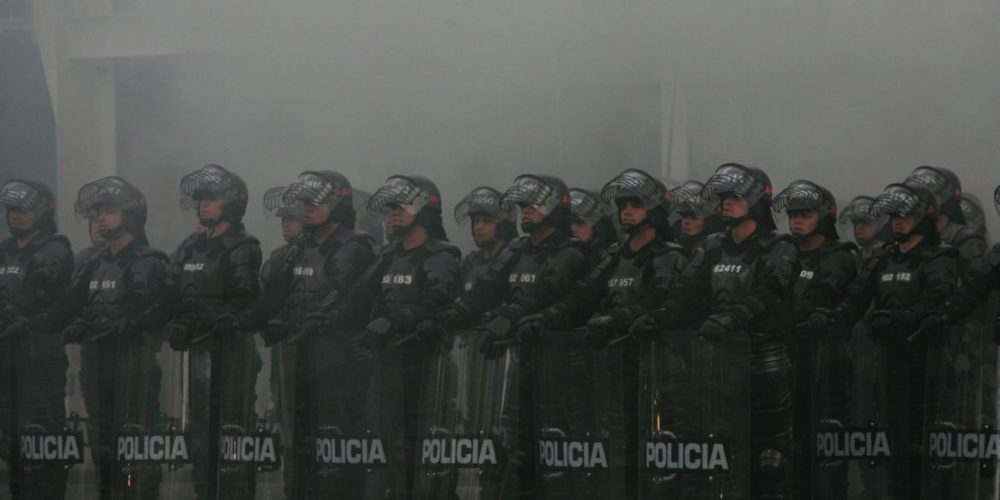
Colombia’s government is moving closer to reinstating a program, suspended in 2015, that would spray herbicides from aircraft over territories where coca is cultivated. Twenty-five U.S. and Colombian organizations have joined on this letter to President Joe Biden urging him to avoid supporting a renewed “fumigation” program, succinctly laying out the reasons why this would be an unfortunate policy mistake. The letter was shared with the White House on March 26.

March 26, 2021

President Joseph R. Biden, Jr.
The White House
Washington, DC

Dear President Biden,

We write out of strong concern about the imminent restart of a program that your administration is inheriting from its predecessor: an effort to eradicate coca in Colombia by spraying herbicides from aircraft. We encourage you not to provide funding for this program, which not only failed to achieve past objectives, but sends a message of cruelty and callousness with which the United States should no longer be associated.  It will undermine the peace accords that are a powerful legacy of the Obama-Biden administration.

Aerial fumigation can bring short-term reductions in the number of acres planted with coca. But past experience shows not only that these gains reverse quickly, but that the strategy undermines other U.S. and Colombian security objectives. Recurring to fumigation is like going back in time, ignoring much that we have learned about what does and does not work.

Many of our organizations have published studies documenting the harm that fumigation has done in the past. The December 2020 report of the U.S. government’s bipartisan Western Hemisphere Drug Policy Commission found that forced eradication brought “enormous costs and dismal results.” Just since the end of February, we have seen strong critiques of forced eradication and fumigation from the International Crisis Group; the Ideas for Peace Foundation, a Colombian business sector think tank; a list of over 200 scholars, and seven UN human rights rapporteurs.

Between 1994 and 2015, a U.S.-backed program supported a fleet of aircraft, and teams of contract pilots and maintenance personnel, that sprayed the herbicide glyphosate over 4.42 million acres of Colombian territory—a land area 3 1/2 times the size of Delaware. In 2015 the Colombian government suspended the spray program, citing public health concerns based on a World Health Organization study finding glyphosate to be “probably carcinogenic to humans.”

For a few years afterward, the Colombian government failed to replace the strategy with anything—neither eradication nor assistance to affected areas. During the late 2010s, Colombia’s coca crop increased to record levels. Nearly all of the increase happened in the exact municipalities and communities where fumigation had been heaviest. After 20 years of constant eradication, farmers continue to face the same on-the-ground reality.

Most Colombian producers of the coca bush are not organized crime-tied criminals or supporters of illegal armed groups. They are families with small plots of land. Estimates of the number of families who make a living off of coca vary from “more than 119,500” to 215,000. If one assumes four people per family, then more than 2 percent of Colombia’s 50 million people depend on coca. Households earn about $1,000 per person per year from the crop, making them by far the lowest-paid link in the cocaine supply chain.

They live in “agricultural frontier” zones where evidence of Colombia’s government is scarce. Paved or maintained roads are nonexistent. The national electric grid is far off. There is no such thing as potable water or land titles. In some areas, even currency is hard to obtain, and stores offer the option of paying for groceries with coca paste. 

These people need to be governed and protected by their state. An aircraft flying anonymously overhead, spraying chemicals on populated areas, is the exact opposite of that. But the program has other important disadvantages:

  • Because it targets poor households in ungoverned areas, chemical fumigation sends a message of cruelty, and associates that message with the United States. Your administration is steadily working to undo the Trump administration’s cruel migratory measures, which imposed suffering on a weak, impoverished population at the U.S.-Mexico border. We ask that you also avoid returning to “deterrence though cruelty” in rural Colombia.
  • Like any eradication without assistance, fumigation further weakens governance and threatens to worsen security in Colombia’s ungoverned territories, where illegal economies and armed groups thrive. Forced eradication, especially when uncoordinated with efforts to physically bring government services into territory, sends families from poverty to extreme poverty, with no official help in sight. This hurts the government’s legitimacy in frontier areas where it badly needs to be built up.
  • After perhaps a short-term drop in cultivation, fumigation is not effective at reducing the coca crop. Past experience shows a high probability of replanting and other means of minimizing lost harvests, in contexts of absent government and few alternative crops.
  • Fumigation goes against what Colombia’s 2016 peace accord promised. That document’s first and fourth chapters offered a blueprint for reducing illicit crops: first by engaging families in substitution programs, and then by carrying out a 15-year “comprehensive rural reform” effort to bring state presence to rural areas. Fumigation was meant to be a last resort, for circumstances when families were refusing opportunities to substitute crops and when manual eradication was viewed as too dangerous. Rushing to fumigate is a slap in the face to brave farmer association leaders who took the risky step of defying traffickers and leading their communities into the fourth chapter’s crop substitution programs.
  • Similarly, fumigation risks large-scale social discord in rural Colombia. In 1996, after the program first got started, much of rural Colombia ground to a halt for weeks or months as mostly peaceful coca-grower protests broke out around the country. Today, farmers are even better organized than they were 25 years ago.
  • Fumigation, meanwhile, may carry risks for human health and the environment. The 2015 WHO document is one of many studies that give us reasonable doubts about the health impacts of spraying high concentrations of glyphosate over populated areas from aircraft. Bayer, the company that purchased glyphosate producer Monsanto, has agreed to settlements with U.S. plaintiffs potentially totaling over $11 billion—another reason for reasonable doubt. While the environmental impacts are less clear, glyphosate’s own labeling warns against spraying near standing water sources, and we are concerned about its use in proximity to rainforest ecosystems. The largest environmental impact, though, is likely to be the way many past farmers have responded after losing crops to fumigation, while remaining in a vacuum of government presence: they move somewhere else and cut down more rainforest to grow coca again.
  • Like all forced eradication unaccompanied by assistance, fumigation is dangerous for the eradicators themselves. In 2013, not long before the program’s suspension, FARC guerrillas shot down two spray planes within the space of two weeks. While planes and their escort helicopters will be more armored than before, the vulnerability remains. Eradication is far safer when it is agreed with communities by a government that is physically present in its own territory.

In March 2020, Donald Trump met with Colombian President Iván Duque and told him, “You’re going to have to spray.” The country’s highest court has required Duque’s government to meet a series of health, environment, consultation, and other requirements. Colombia’s Defense Minister is now predicting that the spraying could restart in April.

This time, U.S. Ambassador Philip Goldberg has stated, the U.S. role in the program won’t be as extensive. Still, during the Trump administration, the State Department supported maintenance of the spray plane fleet, upgrades to bases, and training of eradication personnel, among other services. State Department reports sent to Congress in late February and early March hailed fumigation’s imminent restart as a sign of progress.

Nonetheless, we reiterate our hope that the Biden administration will turn away from supporting Colombia’s spray program while there is still time. The United States should not support aerial fumigation in Colombia again. Nor does it have to. We know what to do. 

Farmers with land titles hardly ever grow coca. Farmers who live near paved roads hardly ever grow coca. Criminal groups are badly weakened by proximity of a functioning government that is able to resolve disputes and punish lawbreaking.

This is a longer-term project, but Colombia’s 2016 peace accord offered a good blueprint for setting it in motion: a fast-moving, consultative crop substitution program, tied to a slower-moving but comprehensive rural reform program. Though those programs exist and parts of the Duque government are carrying them out diligently, they are underfunded and well behind where they should be as accord implementation enters its fifth year.

It’s not too late to help Colombia jumpstart the model offered by Colombia’s peace accord, which the Obama-Biden administration so effectively supported. We urge you to take that path instead of that of renewed fumigation, which we know to be a dead end.

Sincerely,

  • Amazon Watch
  • Center for International Environmental Law
  • Centro Estudios sobre Seguridad y Drogas, Universidad de los Andes (Colombia)
  • Chicago Religious Leadership Network on Latin America
  • Colombia Human Rights Committee
  • Consultoría para los Derechos Humanos y el Desplazamiento (Colombia)
  • Corporación Viso Mutop (Colombia)
  • Drug Policy Alliance
  • Elementa DD.HH. (Colombia/Mexico)
  • Fellowship of Reconciliation: Peace Presence
  • Healing Bridges
  • ILEX Acción Juridica (Colombia)
  • Institute for Policy Studies, Drug Policy Project
  • Institute on Race, Equality, and Human Rights
  • Latin America Working Group
  • Mennonite Central Committee U.S. Washington Office
  • Missionary Oblates
  • Oxfam America
  • Oxfam Colombia
  • Presbyterian Church (USA), Office of Public Witness
  • Presbyterian Peace Fellowship
  • Proceso de Comunidades Negras (Colombia)
  • United Church of Christ, Justice and Witness Ministries
  • Washington Office on Latin America
  • Witness for Peace Solidarity Collective

Read More
image-title

EAD 2021 is an opportunity to advocate for climate justice and support the global movement centered and led by people and communities most vulnerable to climate impacts due to historic racial and colonial inequalities. #EAD2021 hopes to passionately advocate and reimagine a world that lives out the values of justice, equity, and beloved community. 

EAD will include opportunities for worship, advocacy training and workshops on Latin America (see list of workshops below).  Visit the EAD website to learn more about the event.

Early bird registration ends April 7. You can register at https://attendify.co/ecumenical-advocacy-days-pbfNWPy.  Registration fees range from $15.00 – $50.00.   Please contact Marilyn McKenna at mmckenna@crln.orgif registration fees are a barrier to your participation.

Register for EAD before April 7, 2021 if you are interested in participating in the EAD organized lobby day. This gives the EAD staff time to schedule the meetings. If you register after April 7, you are not guaranteed to have a meeting set up for you.

Please contact Marilyn McKenna at mmckenna@crln.org for more information.


Latin America Workshops at Ecumenical Advocacy Days

Monday 4/19
10am CT — MCC, OXFAM, Bread for the World, CWS

Climate Change as a Driver of Forced Migration from Central America
Climate change is increasingly a driver of forced migration and displacement in Central America. As climate change worsens droughts, hurricanes, and crop diseases in the region, individuals are forced by hunger or lack of economic opportunities to leave their homes. Come hear from organizations supporting communities impacted by or facing risks from climate change in Central America. Learn how climate change intersects with other root causes of migration, what works in helping small farmers and communities adapt to a changing climate, and how you can support U.S. policies to address climate change in the region.
Speakers: Susana Lopez from Pastoral de la Tierra San Marcos, Dulce Gamboa, Barbara Ford Peace Center in El Quiché, or Guatemala cluster coordinator

1:30pm CT – Amazon Watch
What is President Biden’s Agenda in the Amazon Rainforest?
As part of his sweeping climate executive order, President Biden mandated the creation of a U.S. government plan to support protection of the Amazon rainforest and other ecosystems that are important for regulating the global climate. How is the plan shaping up? What proposals have Amazonian Indigenous peoples and other grassroots social movements presented to stop destruction of their rainforest territories? What is the U.S. government’s role in regulating the operations of asset managers and banks that finance destruction and human rights violations in the Amazon? How can Congress be helpful?
Speakers: Patricia Gualinga from Ecuador, Moira Birss from Amazon Watch, Peter Hughes from REPAM.

1:30pm CT — MCC [This is from the Eco-Justice track but we are hoping to cross-list it!]
The impact of border walls on endangered species and sacred lands
Since 2017, billions of dollars have been spent to construct new walls on the U.S.-Mexico border. Construction has caused irreparable harm to public lands from Texas to Arizona, extracting millions of gallons of precious groundwater in the desert, encroaching on indigenous lands, severing migration routes and otherwise imperiling protected and endangered species. Dozens of laws that protect the environment, public health, and sacred lands were waived to speed construction. Find out how you can urge the Biden administration and your members of Congress to respond.
Moderator: Tammy Alexander, Director of National Advocacy and Program, Mennonite Central Committee U.S. Panelists: Jennifer Johnson, Border Policy Advisor, Southern Border Communities Coalition, Tricia Cortez, Executive Director, Rio Grande International Study Center, Scott Nicol, Assistant Professor at South Texas College (McAllen) and co-author of two ACLU reports on the history and impacts of walls along the U.S.-Mexico border

Tuesday 4/20
1:30pm CT — LAWG/ELCA
Time for Progress: Advocacy for Just U.S. Foreign & Migration Policies towards Latin America
With a relentless focus on stopping migration, U.S. policy in the last few years has ignored many human rights challenges in the Western Hemisphere, including corruption, weak rule of law, and threats faced by environmental activists, indigenous peoples, women, and the LGBTQ+ community. Now we have the opportunity to restore asylum, protect migrants, and address the root causes of migration for those fleeing Central America and Mexico. There will also be time to ask questions about what we can do to fully reopen diplomatic relations with and travel to Cuba, protect peace in Colombia, and ask our government to prioritize protecting human rights and environmental defenders throughout the Americas. Come discuss with advocates how together we can build a more just immigration and foreign policy towards Latin America in this pivotal year.
Speakers: Lisa Haugaard & Daniella Burgi-Palomino (LAWG), Joaquin Mejia (Jesuit Center ERIC, Honduras), Melissa Vertiz Hernandez, Secretaria Tecnica, Grupo de Trabajo de Politicas Migratorias


Read More
image-title

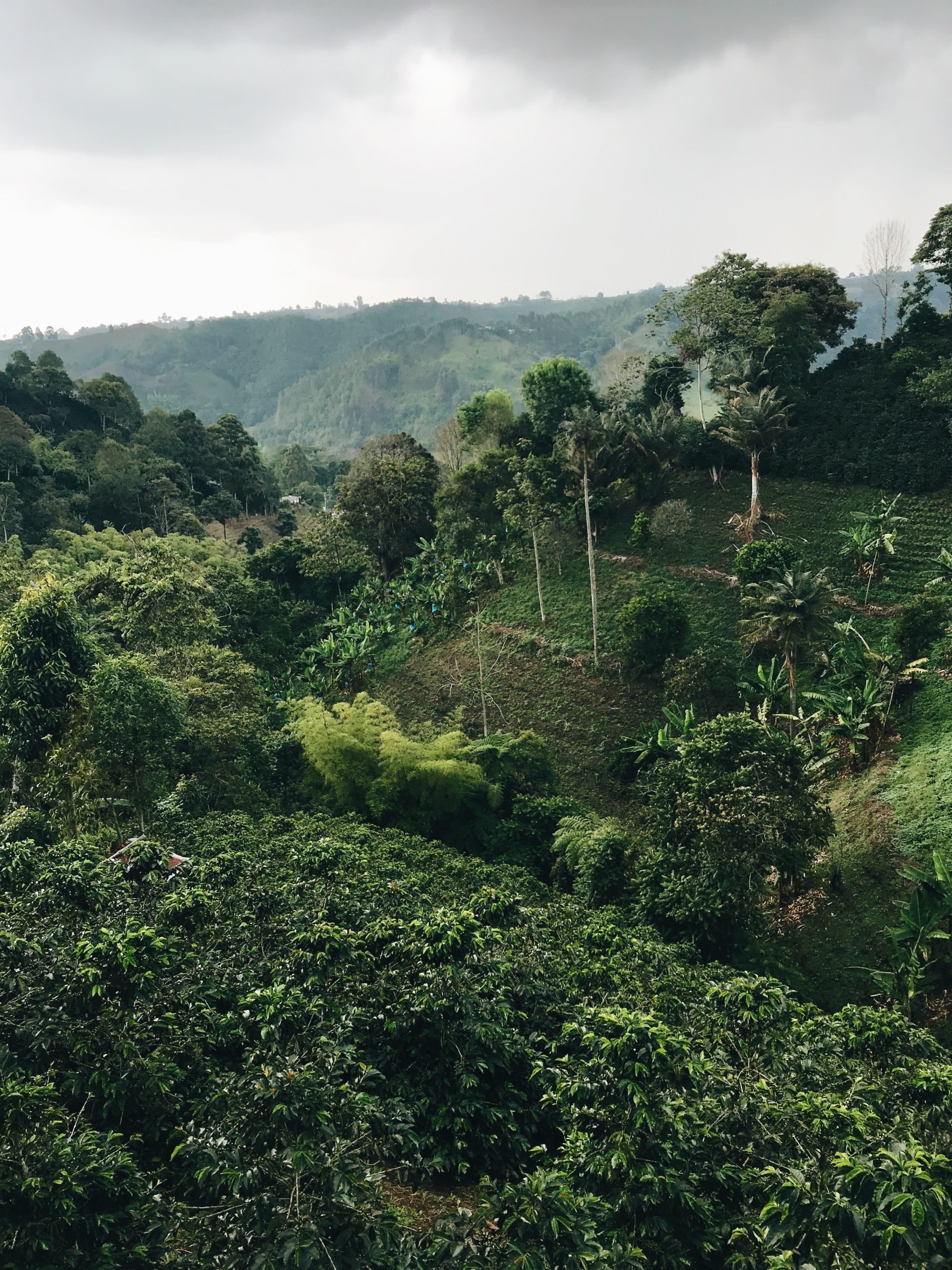
CRLN is seeking congregations to participate in the Days of Prayer and Action for Colombia in April and May of 2021. We will distribute educational resources on Colombia’s Peace Process, the need to implement it fully, and the ever-growing number of victims.  We can work with you to help plan virtual worship and action opportunities for your congregation in April and May. For more information contact Marilyn McKenna at mmckenna@crln.org


Read More
image-title

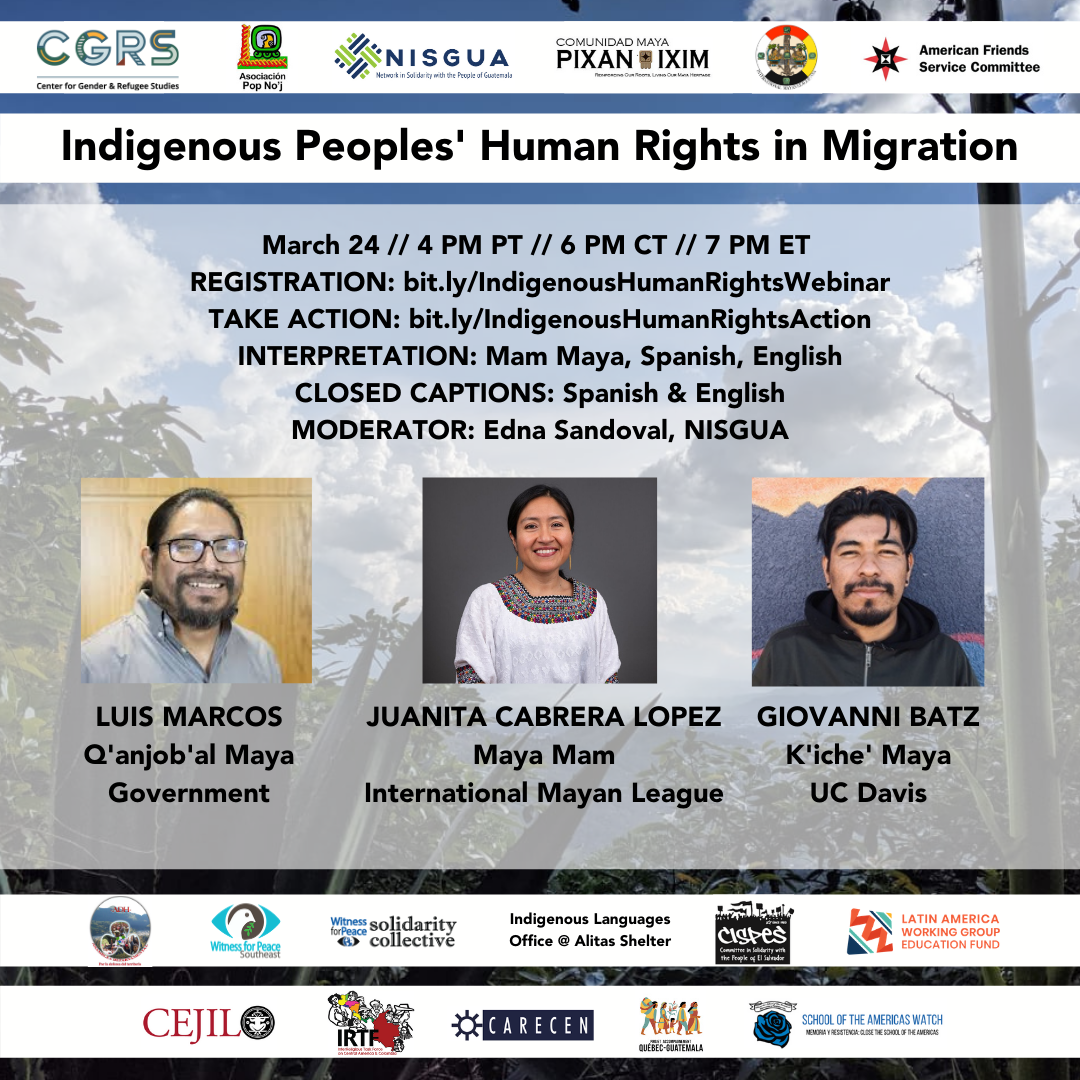
Join us on March 24 at 4 PM PT // 6 PM CT // 7 PM ET for “Indigenous Peoples’ Human Rights in Migration,” a webinar featuring Juanita Cabrera Lopez (Maya Mam), Luis Marcos (Q’anjob’al Maya), Giovanni Batz (K’iche’ Maya). Please share with your networks!

REGISTRATION: https://bit.ly/IndigenousHumanRightsWebinar
TAKE ACTION: https://bit.ly/IndigenousHumanRightsAction

INTERPRETATION: Mam Maya, Spanish, English
CLOSED CAPTIONS: Spanish & English

Read More
image-title
Cuban families in the U.S. initiated a world-wide call for car and bike caravans to say: “End the U.S. sanctions that separate and hurt Cuban families.”  On Sunday October 31 Chicago will join other U.S. cities and many more around the world to support them!

The Caravan will meet at 12 pm (noon) on Sunday, October 31

Assemble at Cermak Plaza
southeast corner of Cermak and Harlem, Southside of McDonalds in Berwyn

  View and download route map here

Statements of solidarity at kick off.  Bring signs to decorate your vehicle.

For more information:  630-915-0654  

Read More
image-title

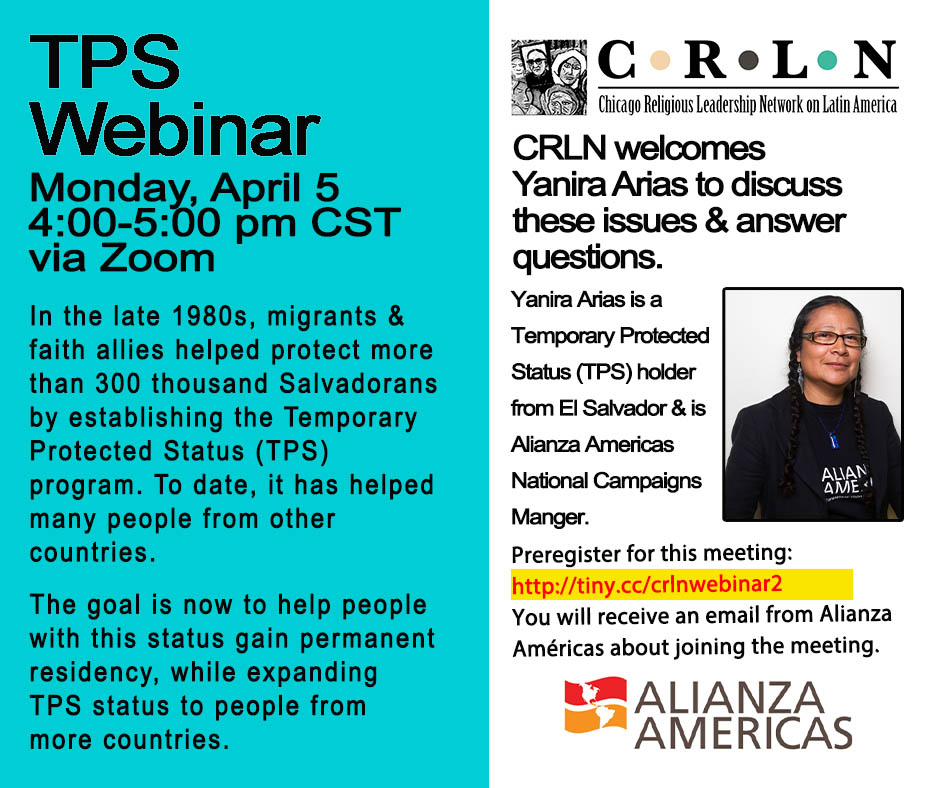
Register at http://tiny.cc/crlnwebinar2

Join us to learn more about advocacy campaigns to gain permanent residency for current TPS holders and to expand TPS to include people from more countries.
After you register you will receive an email from Alianza Americas with zoom information.
Read More
image-title

Good Friday Walk for Justice: Rise Up and Roll Away the Stone! This event stems from the Christian tradition of the Stations of the Cross, where Jesus walked to his execution.  Who is being crucified today and what “stones” block their pathway to new life? At each station, we will name a particular form of injustice and call for transformation. April 2 marks this event’s 41st year, and, like last year, we will participate in the event online. Register for this event here!

This Good Friday, our collective community remembers that we belong to each other. We believe we have the power to rise up together and lean into the strength of our foundational bonds of justice for all.

We have the power to roll away stones of white supremacy, greed, and state violenc e. As we roll the stones away, we commit to co-create systems in which resources are shared, allowing our imaginations to generate radically new ways of living and thriving in a more just society.

We believe that the stone of injustice will be rolled away in our rejection of the status quo. As Easter people we recommit ourselves to choose actions of trans- formation. Together we pledge our efforts to bring about greater justice for all peoples and Earth itself.

Join us as together we reflect, pray, proclaim and celebrate the many ways that together we are Rolling the Stones Away.

To learn more about the walk go to walkforjusticechicago.com.

To support this year’s Walk, make checks payable to CRLN (memo GFWalk) and mail to CRLN, 5655 S. University Ave, Chicago 60637 or online: http://bit.ly/3rHuesZ


If you can’t join us for the zoom worship service you can watch a video and download the prayer booklet at https://crln.org/gfwj/
Read More
image-title

World Premiere of La Lucha Sigue a new film about Honduran land defenders followed by a panel discussion with Bertha Zúniga Cáceres and Miriam Miranda

In Honduras, the most dangerous place in the world to be a land defender, the Lenca and Garífuna people are not backing down. They are fighting to uphold their rights and Indigenous and Black cultures in the face of state backed megaprojects and narco-traffickers who seek to assassinate them, destroy their lands, and erase their existence. Register to watch the WORLD PREMIERE of La Lucha Sigue at 2:00 pm CT Saturday March 20 as part of the Building Movements in Defense of Life, a free bilingual film festival featuring true stories of resistance to industrial capitalism.  Stay after the film for a panel featuring the protagonists of the film, Bertha Zúniga Cáceres and Miriam Miranda on Saturday at 3:30 PM CT.

On Sunday at 3:30 PM CT Bertha and Miriam will join a panel with all the women featured in the film festival. You will need to register for the Sunday panel separately and select large group discussion.  See the whole schedule and register at:  https://www.mutualaidmedia.com/schedule


Read More
image-title

Rep. Hank Johnson (D-GA) has reintroduced the Berta Caceres Human Rights in Honduras Act (H.R. 1574) into the 2021-2022 session of the House of Representatives. This is the fourth session of Congress in which it has been assigned to a committee. We need your voice to make sure it passes out of committee this time so that the House has the chance to vote on it. A sample script for an email and phone call to your Representative, asking them to co-sponsor H.R.1574, follows the description of the bill below.

The bill calls for the suspension of all U.S. aid to Honduran security forces and for the U.S. to vote no on all loans from multinational development banks to Honduras, until the following conditions are met:

– Pursued all legal avenues to bring to trial and obtain a verdict of all those who ordered and carried out (1) the murder of Berta Cáceres, (2) the killings of over 100 small-farmer activists in the Aguán Valley, (3) the killings of 22 people and forced disappearance of 1 person by state security forces in the context of the 2017 postelectoral crisis, (4) the May 3, 2016 armed attack on Félix Molina, and the November 26, 2018 shooting of Geovany Sierra,  (5) the July 18, 2020, forced disappearances of 4 Garifuna community leaders from Triunfo de la Cruz who were taken from their homes by heavily armed men wearing bulletproof vests and police uniforms; and (6) the December 26, 2020, killing of indigenous Lenca leader Felix Vasques in La Paz, and the December 28, 2020, killing of indigenous Tolupan leader Adan Mejia in Yoro;

-Investigated and successfully prosecuted members of military and police forces who are credibly found to have violated human rights, and ensured that the military and police cooperated in such cases, and that such violations have ceased;

-Withdrawn the military from domestic policing, in accordance with the Honduran Constitution, and ensured that all domestic police functions are separated from the command and control of the Armed Forces of Honduras and are instead directly responsible to civilian authority;

-Established the effective protection of the rights of trade unionists, journalists, human rights defenders, the Indigenous, the Afro-Indigenous, small-farmers, and LGBTI activists, critics of the government, and other civil society activists to operate without interference; and

-Taken effective steps to fully establish the rule of law and to guarantee a judicial system that is capable of investigating, prosecuting, and bringing to justice members of the police and military who have committed human rights abuses.

Instructions for your call and email: Call the Capitol Switchboard at (202) 224-3121 and ask to be connected to your Representative. When you are connected to their office, ask to speak to the foreign policy staffer. Be sure to get the name and email address of the foreign policy staffer so you can follow up with your message in writing. If the foreign policy aide is not available, ask to leave a message on their voice mail. After you leave the message, send an email to the aide with your message.

Sample script: “My name is _____. I am a constituent from Rep. ___________’s district. I am calling (or writing) to ask Representative _____ to co-sponsor the Berta Caceres Human Rights in Honduras Act, H.R. 1574. The bill calls for the suspension of security aid to Honduras until human rights violations by Honduran security forces cease and the perpetrators have been brought to justice. Have you seen the bill? Would you bring it to the attention of Representative _______ ? Can I count on Representative _____________to join as a cosponsor?  Please call me this week at (your phone number) to let me know if you have seen the bill, and if Representative _____ will support it. For more information or to co-sponsor the bill, please contact Chelsea Grey (chelsea.grey@mail.house.gov) in Rep. Johnson’s (GA) office.”

Note: Please do not contact Chelsea Grey yourself. Ask your Representative’s staff person to do this.

Please contact Sharon at shunter-smith@crln.org when you send your message and call, especially if you get a response.     

Read More